Definition
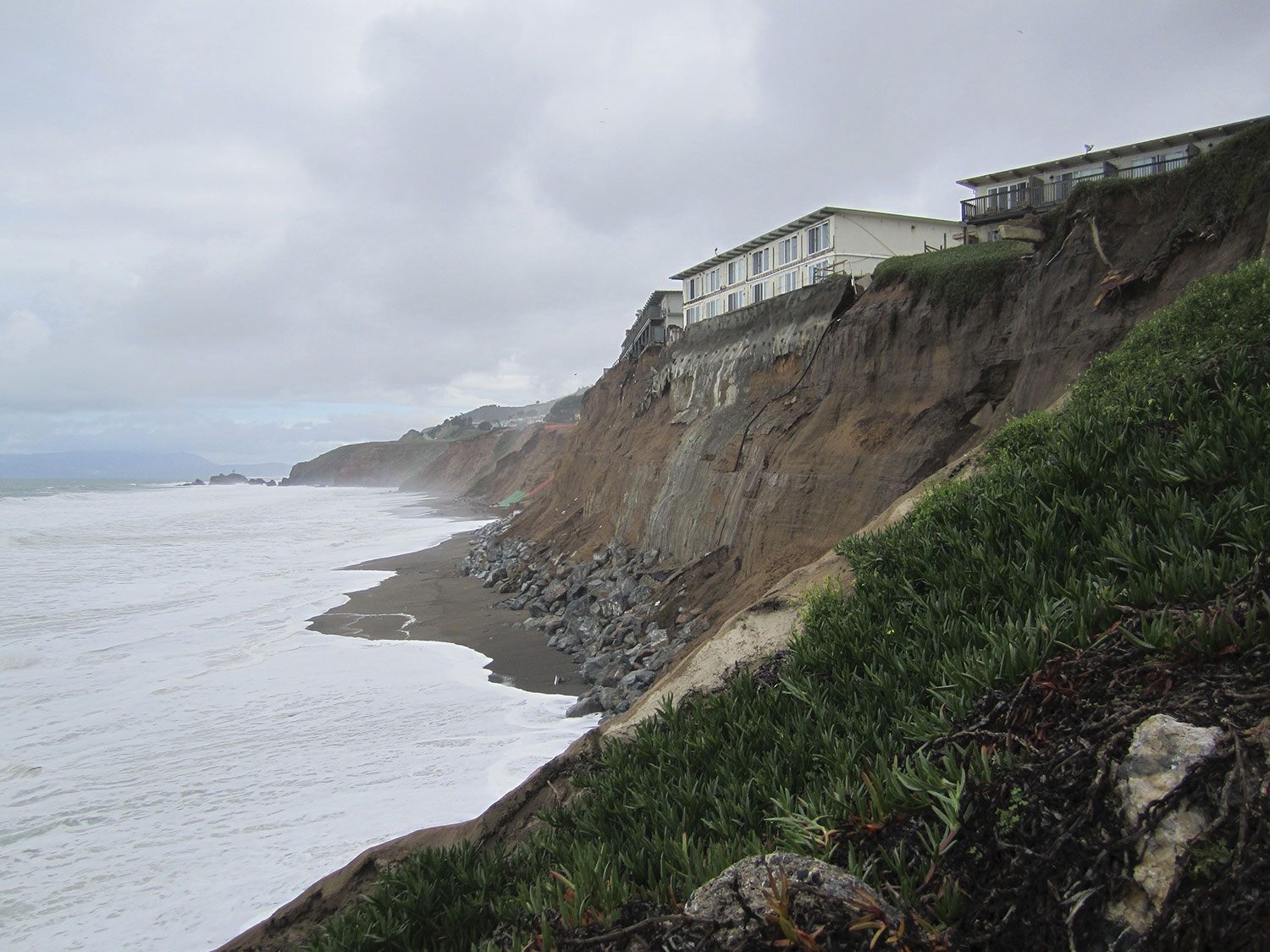
A coastal cliff is a steep, often near-vertical rock face formed where land meets the sea and wave action, combined with weathering, erodes the shoreline faster than gentler slopes can develop. Coastal cliffs are among the most actively eroding landforms on Earth, because they sit at the direct boundary between relentless wave energy and exposed rock. Their height and steepness depend heavily on the strength of the local rock and the intensity of wave exposure, ranging from modest low bluffs to some of the tallest sea cliffs in the world.
How It Forms
Coastal cliffs develop through the combined, continuous action of several processes working at the land-sea boundary.
- Waves attack the base of the shoreline.
Breaking waves repeatedly strike the coastline, and their mechanical force, along with sediment they carry, abrades and undercuts rock at the base of the slope.
- Weak points erode fastest.
Cracks, joints, and softer rock layers erode more quickly than surrounding material, often creating notches, small caves, and other irregular features at the base of the cliff first.
- Undercutting removes support from above.
As erosion continues to hollow out the base, the overlying rock loses support and eventually becomes unstable.
- Rockfall and collapse create a new vertical face.
Unsupported rock periodically collapses in rockfalls or larger landslides, creating a fresh, steep cliff face and temporarily piling debris at the base, which waves then work to remove.
- The cliff retreats landward over time.
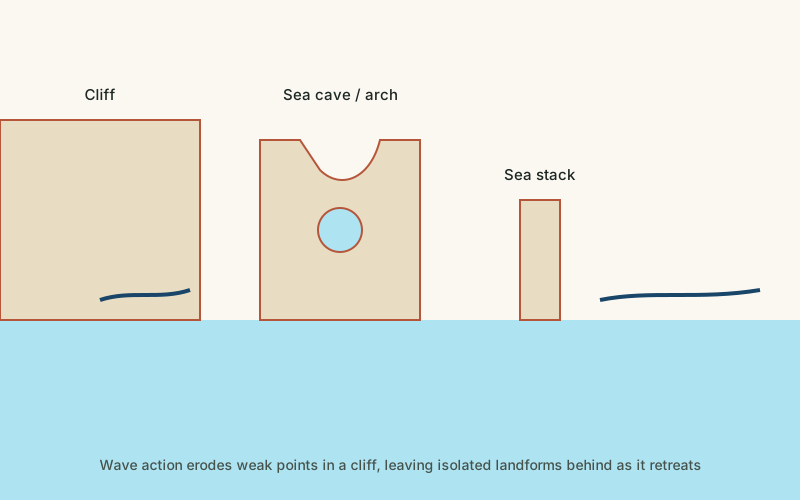
This repeated cycle of undercutting and collapse causes the entire cliff line to retreat gradually inland, sometimes leaving isolated features like sea stacks behind where erosion was uneven.
Formation Timescale
The rate at which coastal cliffs retreat varies enormously depending on rock type and wave exposure, from well under a centimeter per year in very resistant rock to several meters per year in soft, unconsolidated material exposed to powerful waves. Because this rate depends on so many local factors, including storm frequency and sea-level trends, there is no single figure that applies to coastal cliffs generally; monitoring agencies typically track retreat rates separately for each specific stretch of coastline rather than relying on a global average.
Main Characteristics
- Steep to near-vertical rock face: cliffs maintain a much steeper profile than ordinary hillsides because erosion continuously removes material at the base.
- Active base erosion (undercutting): wave attack is typically concentrated at or near the cliff's base rather than evenly across its height.
- Talus and debris at the base: fallen rock from collapses often accumulates at the foot of a cliff until waves gradually remove it.
- Irregular, feature-rich shoreline: caves, arches, and stacks frequently develop where erosion proceeds unevenly along a cliff line.
- Exposed rock stratigraphy: cliff faces often reveal clear layered rock, useful for studying the region's geological history.
Materials and Structures Involved
The rock type exposed in a coastal cliff strongly determines how it erodes. Chalk and soft limestone cliffs, such as those found at the Seven Sisters in England, erode relatively quickly and tend to produce bright white rock faces with periodic dramatic collapses. Harder igneous or metamorphic rock, such as basalt or granite, erodes far more slowly and can maintain extremely tall, stable cliff faces over long periods. Layered sedimentary rock often erodes unevenly, with softer layers wearing away faster and undercutting more resistant layers above them. The angle and orientation of rock layers relative to the coastline also matters: layers that tilt toward the sea tend to fail more readily than those tilting inland, since gravity and water infiltration both work with the slope rather than against it.
Climates and Environments
Coastal cliffs occur wherever land meets open or semi-exposed water with enough wave energy to actively erode the shoreline, from temperate coastlines to tropical and polar ones. Storm frequency and intensity strongly influence erosion rates, with a small number of major storms sometimes causing more cliff retreat than years of ordinary wave action. In colder climates, freeze-thaw weathering adds an additional mechanism that weakens rock, working alongside wave erosion rather than replacing it. Prevailing wind direction and the angle at which a coastline faces incoming storms also matter considerably, since a cliff exposed directly to the dominant storm track generally erodes faster than a similar cliff in a sheltered bay nearby.
Real Examples
The Cliffs of Moher in Ireland rise dramatically from the Atlantic Ocean and are cut into layered sedimentary rock that has eroded unevenly along weaker bedding planes. The Seven Sisters in England are a series of bright white chalk cliffs that retreat relatively quickly due to the softness of the rock. The Bunda Cliffs in Australia form one of the longest unbroken sea cliff lines in the world along the Great Australian Bight. The Na Pali Coast in Hawaii exposes steep volcanic cliffs shaped by both wave erosion and heavy tropical rainfall.
How It Continues to Change
Coastal cliffs are among the most actively changing landforms described on this site, with erosion, rockfall, and collapse continuing essentially all the time at some point along any exposed cliff line. Rising sea levels and increased storm intensity in some regions are measurably accelerating cliff retreat, creating challenges for communities and infrastructure built near the coast. Engineers and coastal managers in many areas actively monitor cliff stability and, in some cases, attempt to slow erosion artificially, though this can sometimes simply shift erosion to neighboring unprotected sections of coastline.
Monitoring methods range from periodic surveying and photography to more advanced techniques like laser scanning, which can detect subtle changes in a cliff face between successive surveys. This data helps researchers and local authorities identify which sections of a coastline are retreating fastest and plan accordingly, whether that means restricting access, relocating infrastructure, or simply accepting that a particular stretch of cliff will continue to retreat regardless of intervention.
How It Differs From Similar Formations
Coastal cliffs are closely related to the broader category of coastal erosion landforms, which includes the caves, arches, and stacks that often develop along an eroding cliff line as secondary features. They differ from inland cliffs or canyon walls mainly in the dominant erosive force: coastal cliffs are shaped primarily by wave action, while inland cliffs are usually shaped by river erosion, weathering, or tectonic exposure without ocean involvement. Coral atolls, by contrast, typically have very low-lying coastlines rather than cliffs, since they build up from biological reef growth rather than eroding resistant rock.
Common Misconceptions
Misconception: Coastal cliffs erode at a steady, predictable rate.
Reality: Cliff retreat is often episodic, with long quiet periods punctuated by sudden collapses during major storms, rather than a smooth, continuous process.
Misconception: Taller cliffs are always more resistant to erosion.
Reality: Cliff height depends on local geology and uplift history, not resistance to erosion; tall cliffs in soft rock can still retreat quickly.
Misconception: Coastal erosion only affects the cliff face itself.
Reality: Cliff erosion also affects beaches, nearby ecosystems, and human infrastructure, since eroded material and changing shorelines influence the wider coastal system.
Key Terms
- Erosion — The wearing away and removal of rock, soil, or sediment by natural forces such as water, wind, or ice.
- Abrasion — The wearing away of rock surfaces by friction, as sediment carried by ice, water, or wind scrapes against bedrock.
- Escarpment — A steep slope or cliff that marks a sharp change in elevation, often separating two relatively flat areas.
- Talus — An accumulation of broken rock fragments at the base of a cliff or steep slope, formed by repeated rockfall.
- Weathering — The breakdown of rock in place, through physical, chemical, or biological processes, without the material being transported away.
- Bedrock — The solid rock that lies beneath soil, sediment, and other loose surface material.