Definition
A natural arch is a freestanding rock formation with an opening passing all the way through it, created when erosion removes the weaker rock from the middle of a narrow ridge, wall, or headland while leaving a span of stronger rock intact overhead. Unlike a cave, which is an opening into a solid rock mass, an arch is defined by the fact that light and air pass completely through it from one side to the other. Arches form in deserts, where wind and occasional heavy rain attack exposed sandstone fins, and along coastlines, where ocean waves batter headlands from both sides until they punch through. Despite their solid appearance, every natural arch is a temporary structure caught partway through its own destruction.
How It Forms
Most natural arches begin as a long, thin wall of rock called a fin, left standing after the rock around it has eroded away. From that starting point, the arch itself forms through a predictable sequence of weakening, hollowing, and eventual breakthrough, though the exact pace and shape depend heavily on the type of rock and climate involved.
- A fin of resistant rock is isolated.
In sandstone desert country, parallel vertical cracks called joints slice through rock layers. Over long stretches of time, erosion widens these joints and strips away the rock between them, leaving behind narrow, free-standing walls, or fins, separated by open gaps on either side.
- Water finds the weak point.
Rainwater seeps into small cracks and bedding planes within the fin. In cold climates it freezes and expands, wedging the rock apart; in all climates it dissolves weak natural cement between sand grains and carries loose material away. Softer or more fractured sections of the fin erode faster than the surrounding rock.
- A hole forms and widens.
Once erosion breaks all the way through the thinnest, weakest part of the fin, a small opening appears. Wind then accelerates the process, scouring sand and dust through the gap and sandblasting its inner surfaces, which widens the opening far faster than exposed rock faces erode on their own.
- The arch is shaped and thinned.
Continued weathering smooths and enlarges the opening while the span above it grows progressively thinner. Along coastlines, this same widening happens as waves attack a headland from both sides until a sea cave breaks through to daylight, producing a sea arch rather than a desert one.
- The span eventually fails.
Every arch is being thinned at the same time it is being admired. Gravity, frost, and continued weathering eventually weaken the span beyond what it can support, and the arch collapses, usually suddenly, leaving behind two separate rock pillars or a pile of rubble where the opening once stood.
Formation Timescale
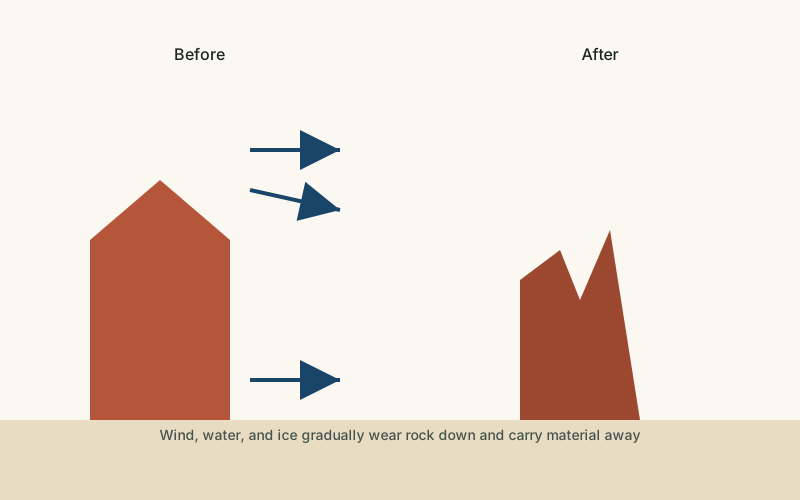
Arch formation unfolds over long stretches of geological time, though no single figure applies to all of them. Scientists estimate that many sandstone arches in the American Southwest took tens of thousands to a few hundred thousand years to open fully, after the surrounding rock had already spent millions of years being deposited, buried, and later exposed by erosion. Coastal arches can form and collapse far faster, sometimes within a human lifetime, because ocean waves erode rock much more aggressively than wind and rain alone. The lifespan of an existing arch is similarly uncertain: some collapse within decades of being first documented, while others appear stable for centuries. Researchers who monitor arches with sensors have found that many vibrate constantly in response to wind, traffic, and even distant earthquakes, a reminder that the timing of final collapse is inherently unpredictable.
Main Characteristics
- A full opening: true arches have an opening that passes completely through the rock, distinguishing them from alcoves or shallow caves.
- A thin, curved span: the rock overhead is typically much thinner than the pillars supporting it, since that thinness is the product of ongoing erosion.
- Origin in a fin or headland: almost all arches begin as a narrow ridge or peninsula of rock isolated by erosion on either side.
- Resistant cap rock: arches usually form where a harder, more erosion-resistant rock layer overlies a softer one that erodes away faster.
- Instability: unlike many landforms described as stable features, an arch is a structure actively progressing toward collapse.
Materials and Structures Involved
Most of the world's famous desert arches are carved from sandstone, a sedimentary rock made of sand grains cemented together, often originally deposited as ancient dune fields or river sediment. Sandstone is ideal for arch formation because it is strong enough to hold a span together temporarily, yet soft enough, and riddled with enough natural cracks and bedding planes, to erode relatively quickly compared to harder rock. Coastal arches, by contrast, can form in a wider range of rock types, including limestone and volcanic rock, because ocean wave energy is powerful enough to carve openings that wind alone could never produce in those harder materials. In both settings, the strength and fracture pattern of the specific rock layer involved determines how large an arch can grow before it fails.
Climates and Environments
Desert arches depend on a climate dry enough that rock is rarely saturated with water for long periods, which would weaken it uniformly rather than concentrating erosion at cracks and joints. Arid regions also experience large daily and seasonal temperature swings, which stress rock through repeated expansion and contraction and help pry apart already-weakened sections. Coastal arches form under an entirely different set of conditions, where constant wave action, salt spray, and storm surges replace wind and frost as the dominant erosional force. Both settings share one requirement: a long-term balance between a rock strong enough to span an opening and weak enough to be hollowed out in the first place.
Real Examples
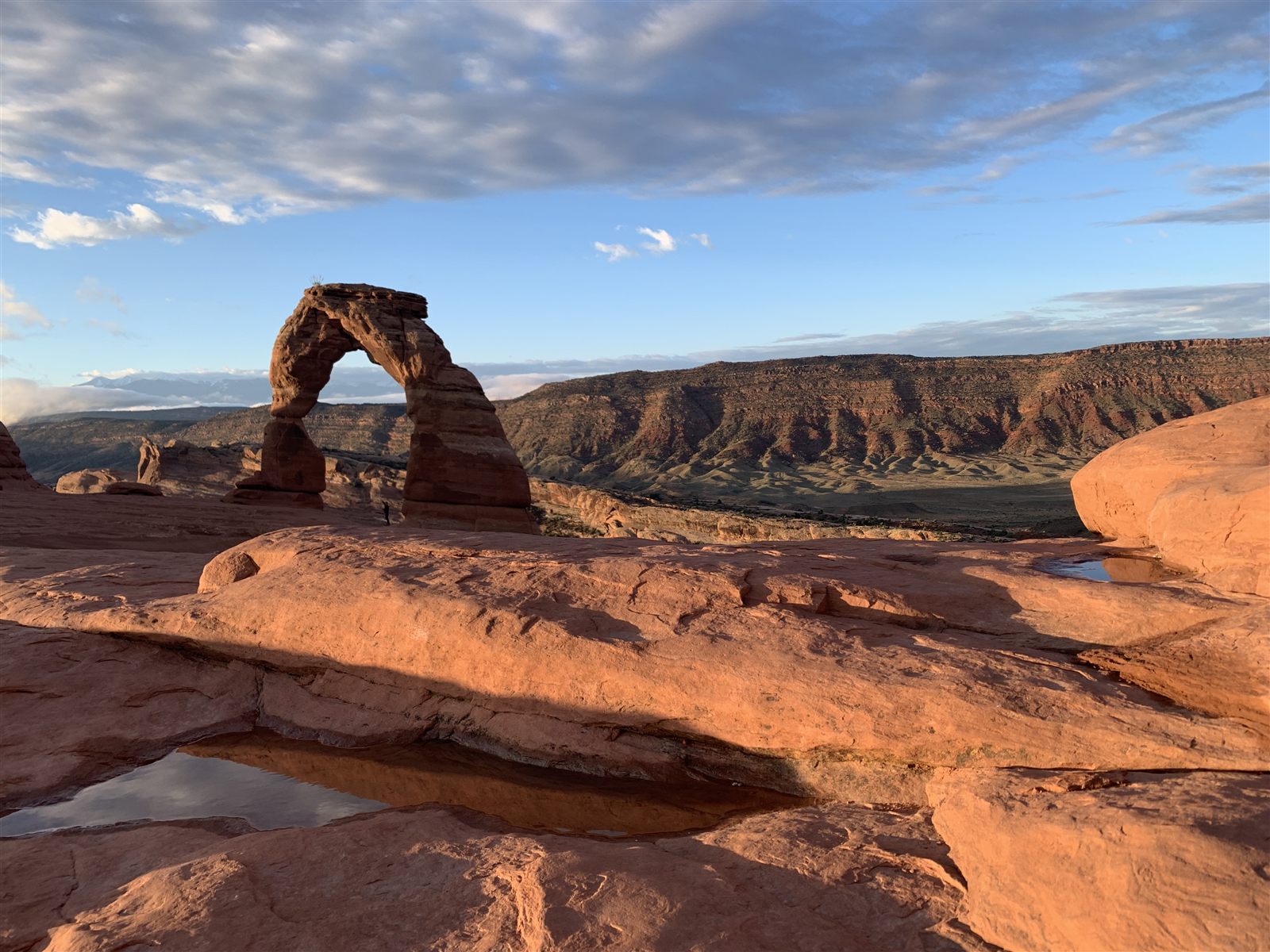
Delicate Arch, in Arches National Park in Utah, is one of the most photographed natural arches in the world and stands on a bedrock pedestal that has itself been shaped by the same erosional forces that carved the arch above it. Landscape Arch, also in Arches National Park, has one of the longest known spans of any natural arch, and a large slab fell from its thinnest section in 1991, a reminder that these features change without warning. Rainbow Bridge, also in Utah, is one of the largest known natural bridges, formed where a stream cut through a sandstone fin rather than wind and rain alone. Durdle Door, on the coast of southern England, shows how the same basic principle, erosion hollowing out a weak point until it breaks through, produces an arch from limestone battered by ocean waves rather than desert sandstone.
How It Continues to Change
Arches never stop changing. Wind continues to scour the inner surfaces of desert arches, slowly enlarging their openings and thinning their spans, while frost wedging and occasional rockfall remove material from the underside and edges. Coastal arches are reshaped even faster by storms, which can widen an opening or trigger a partial collapse within a single season. Every arch currently standing is also a preview of what comes next for other fins nearby: new openings are forming in unseen fractures even as older, more famous arches edge closer to failure. Collapse, when it finally happens, usually leaves behind two isolated rock pillars, which themselves will continue eroding until nothing recognizable remains.
How It Differs From Similar Formations
Natural arches are often confused with the deep, narrow passages found in canyons, but a canyon is cut downward into the land by a river or stream, while an arch is a span left standing after the rock around and beneath it has eroded away. Arches are also related to, but distinct from, the limestone dissolution features found in karst landscapes: karst caves and arches form primarily through the chemical dissolving of limestone by slightly acidic water, while most desert sandstone arches form through mechanical erosion and frost action acting on cracks in the rock. Both processes can produce an opening that looks similar from a distance, but the chemistry and rock type involved are usually quite different.
Common Misconceptions
Misconception: Natural arches are permanent landmarks that will always look the way they do today.
Reality: Every arch is actively eroding and will eventually collapse. Some well-known arches have already fallen within recorded history, and researchers cannot predict exactly when any individual arch will fail.
Misconception: Arches form mainly because a river or stream carved a channel straight through solid rock.
Reality: Most desert arches form from erosion acting on cracks in an already-isolated rock fin, not from flowing water cutting a new passage. Flowing water is the main cause only for the smaller category of natural bridges.
Misconception: Touching, climbing on, or standing under an arch has no real effect on it.
Reality: Many arches are more fragile than they look, and additional weight, vibration, or chemical residue from skin contact can accelerate stress on an already-thinning span, which is why many parks restrict climbing on named arches.
Key Terms
- Erosion — The wearing away and removal of rock, soil, or sediment by natural forces such as water, wind, or ice.
- Weathering — The breakdown of rock in place, through physical, chemical, or biological processes, without the material being transported away.
- Chemical Weathering — The breakdown of rock through chemical reactions, such as the dissolving of limestone by slightly acidic water.
- Sedimentary Rock — Rock formed from the compaction and cementation of accumulated sediment over time.
- Bedrock — The solid rock that lies beneath soil, sediment, and other loose surface material.
- Hoodoo — A tall, thin spire of rock left standing after surrounding softer rock has eroded away, common in badlands.