Definition
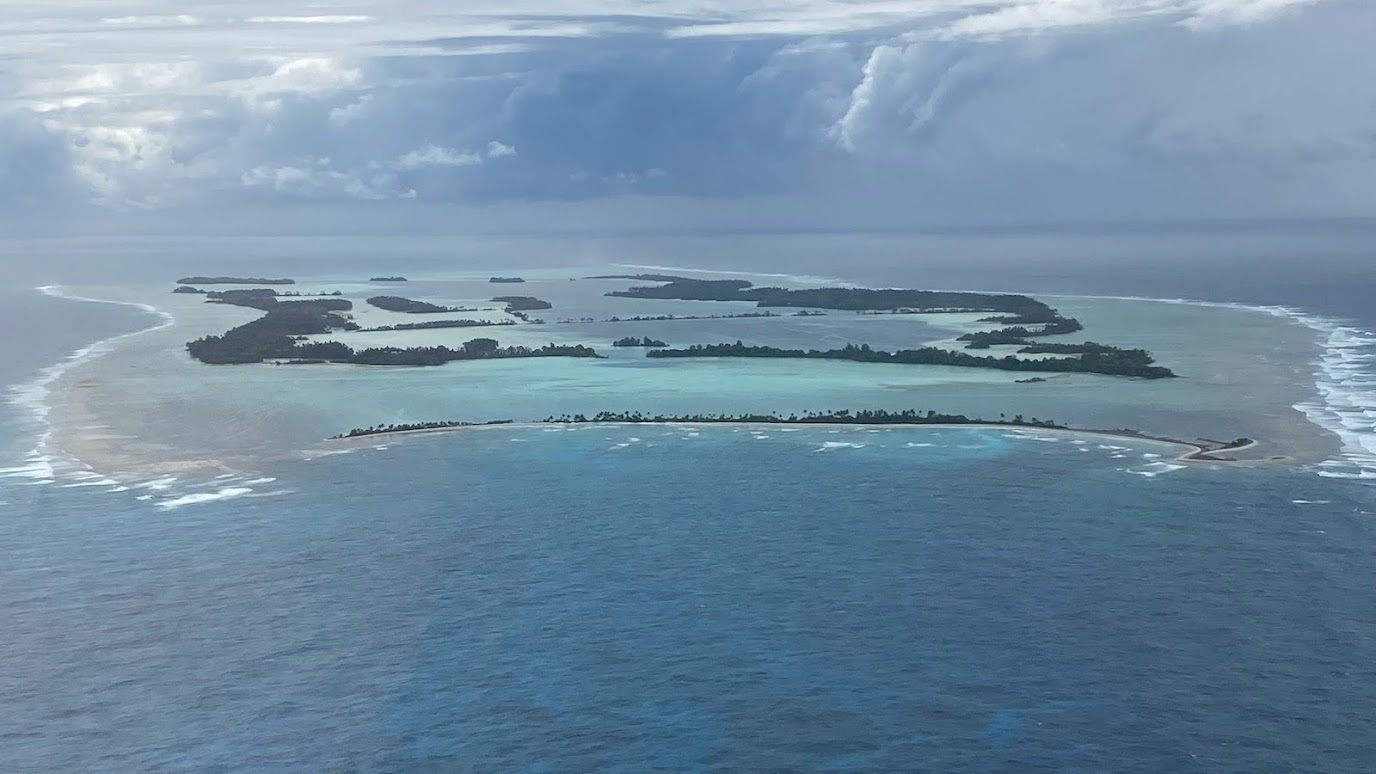
A coral atoll is a ring-shaped or horseshoe-shaped coral reef, often enclosing a central lagoon, that forms around the former location of a volcanic island. Unlike most other landforms covered on this site, an atoll's shape is determined as much by biology as by geology: living coral organisms build the reef structure, while the slow sinking of volcanic rock beneath it determines the atoll's overall footprint and timing. Atolls are typically low-lying, with most of their land area standing only a few meters above sea level.
How It Forms
The formation of a coral atoll follows a sequence first proposed by Charles Darwin in the nineteenth century and since confirmed by extensive geological study, often described in three broad stages.
- A volcanic island forms and a fringing reef develops.
A volcanic island rises from the ocean floor, typically over a hot spot or near a plate boundary, and coral begins growing in the shallow water directly along its coastline, forming a fringing reef.
- The island begins to subside.
Over millions of years, the oceanic crust beneath the volcano cools, contracts, and sinks under its own weight, causing the island itself to gradually subside relative to sea level.
- Coral grows upward to stay near the surface.
Because coral needs sunlight and can only grow within a limited depth range, the reef keeps growing upward as the island sinks, maintaining its position near the surface even as the volcanic rock beneath it descends.
- A barrier reef forms as the island shrinks.
As the island continues to subside and erode, a wider lagoon opens up between the shrinking volcanic remnant and the reef, now classified as a barrier reef rather than a fringing one.
- The volcano disappears, leaving a ring-shaped atoll.
Eventually the volcanic island sinks entirely below the surface, leaving only the coral ring and its enclosed lagoon — a fully formed atoll with no remaining visible volcanic peak.
Formation Timescale
The transition from a volcanic island to a mature coral atoll typically takes on the order of tens of millions of years, since it depends on the slow pace of oceanic crust subsidence. However, coral growth itself can be relatively fast under favorable conditions, with some reef-building corals capable of adding several centimeters of vertical growth per year, which is generally sufficient to outpace typical subsidence rates as long as conditions remain favorable for coral health. Because conditions like water temperature, sea level, and ocean chemistry can disrupt coral growth, the timing of atoll formation is not perfectly uniform across different island chains.
Main Characteristics
- Ring or horseshoe shape: the defining visual feature of a mature atoll, reflecting the former outline of a volcanic island.
- Central lagoon: a shallow, relatively calm body of water typically occupies the space once filled by the volcanic island itself.
- Low elevation: atoll islands are generally built from coral sand and rubble and rarely rise far above sea level.
- Living reef structure: the atoll's outer edge is maintained by ongoing coral growth, making it a biologically active landform, not a purely static one.
- No remaining volcanic peak: true atolls, unlike fringing or barrier reef islands, no longer have visible volcanic rock above the surface.
Materials and Structures Involved
Atolls are built primarily from calcium carbonate produced by coral polyps and other reef-building organisms, along with the skeletal remains of associated marine life such as mollusks and coralline algae. Over time, wave action breaks down some of this reef material into coral sand and rubble, which accumulates on parts of the reef rim to form the low islands where atoll communities often live. Beneath this biological material lies the original volcanic rock, now buried far below the surface under both the reef structure and, in many cases, additional layers of ocean sediment.
Climates and Environments
Coral atolls are restricted to warm tropical and subtropical waters where reef-building coral can thrive, generally requiring consistently warm sea temperatures and clear, sunlit, shallow water. Most of the world's atolls are concentrated in the Pacific and Indian Oceans. Because atoll islands sit so close to sea level, they are particularly sensitive to changes in sea level and to disruptions in coral health, including warming-related coral bleaching, which can weaken the very structure that maintains the island above water.
Real Examples
Bikini Atoll in the Marshall Islands is a well-documented atoll formed around a now fully submerged ancient volcanic peak. The Maldives consist of numerous atolls built along an underwater volcanic ridge, making the country one of the lowest-lying nations on Earth. The atolls of Kiribati in the central Pacific similarly sit atop subsided volcanic foundations. Aldabra Atoll in the Indian Ocean, part of Seychelles, is one of the largest raised coral atolls in the world and supports a notably isolated ecosystem.
How It Continues to Change
Atolls remain dynamic even once fully formed, since their coral reef structure continues to grow, be damaged by storms, and recover over time under normal conditions. Rising sea levels pose a particular challenge for atoll nations, since there is little margin between current land elevation and the sea, and the ability of coral and sediment accumulation to keep pace with sea-level rise varies by location and is an active area of scientific study. Coral health itself is also sensitive to ocean temperature and acidity, both of which affect how well an atoll's reef structure can maintain itself over time.
Some atoll islands have been observed to shift shape or even grow in total land area over recent decades as storm-driven sediment is redistributed across the reef flat, even while other islands within the same atoll lose land, showing that the relationship between sea-level rise and island change is more complex than a simple uniform retreat. Researchers continue to study exactly how different atolls are likely to respond as conditions continue to change.
How It Differs From Similar Formations
Atolls are closely related to volcanic islands in general, representing essentially the final stage in the life cycle of a reef-fringed volcanic island after the volcanic peak has fully subsided. They differ from raised limestone islands, which were once atolls or reef platforms but have since been tectonically uplifted above sea level rather than remaining at the surface through ongoing coral growth. Atolls are also distinct from mainland coastal cliffs, since atoll shorelines are built up from biological reef material rather than eroded from pre-existing solid rock.
Common Misconceptions
Misconception: Atolls are the remains of a volcanic crater.
Reality: An atoll's ring shape comes from coral growing around the former coastline of a subsiding volcanic island, not from the shape of a volcanic crater itself.
Misconception: Atoll islands are solid rock.
Reality: The visible land on most atolls is built from accumulated coral sand and rubble sitting on top of the reef structure, not solid volcanic or continental rock.
Misconception: Coral reefs and atolls are the same thing.
Reality: An atoll is a specific ring-shaped landform that results from reef growth around a subsiding island; many coral reefs exist without ever forming a complete atoll.
Key Terms
- Subduction — The process in which one tectonic plate is forced beneath another at a convergent boundary and sinks into the mantle.
- Basalt — A dark, fine-grained volcanic rock formed from rapidly cooled lava, rich in iron and magnesium.
- Hot Spot — A location where unusually hot material rises from deep within the mantle, producing volcanic activity independent of plate boundaries.
- Erosion — The wearing away and removal of rock, soil, or sediment by natural forces such as water, wind, or ice.
- Isostasy — The gravitational balance between the Earth's crust and the denser mantle beneath it, which causes crust to rise or sink as weight is added or removed.