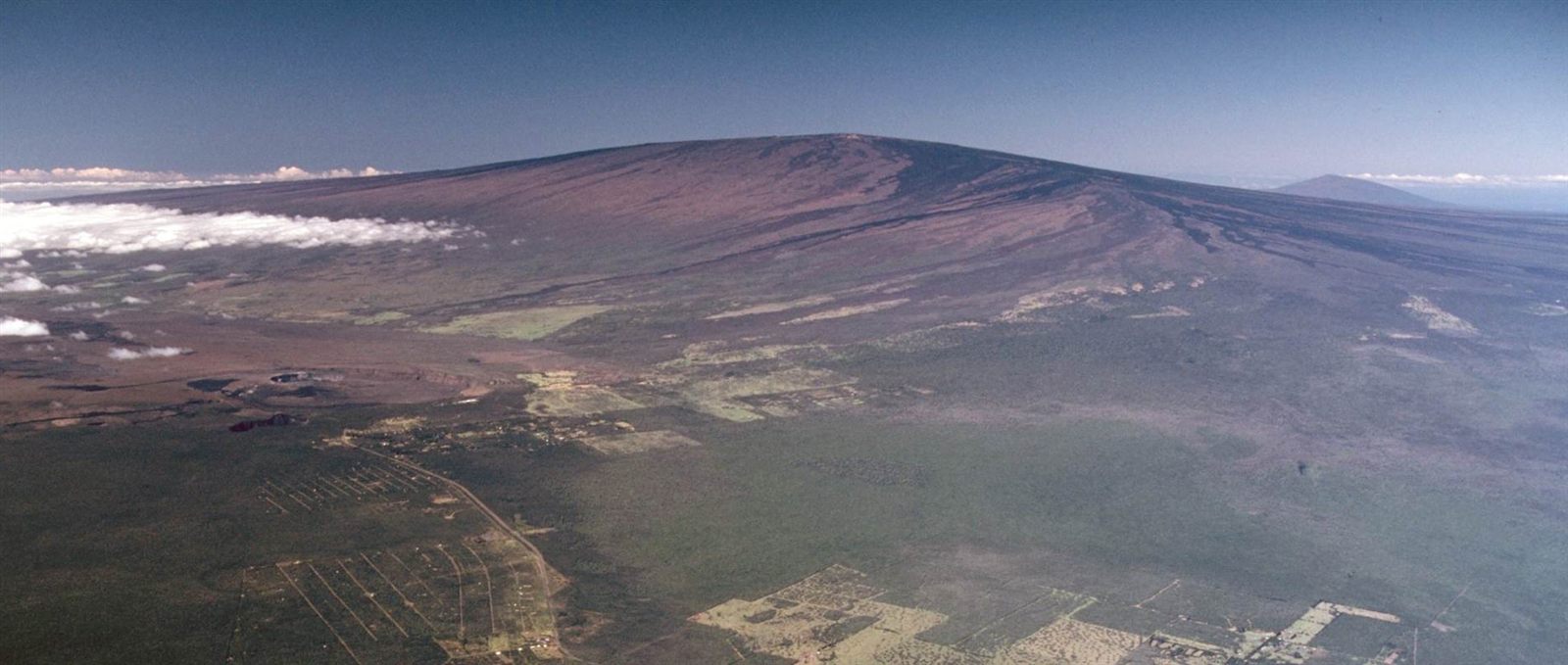
Definition
An island is any landmass, smaller than a continent, that is completely surrounded by water. Despite that simple shared definition, islands form through at least two very different kinds of geological history. Volcanic islands are built from the surface upward, as repeated eruptions pile lava and ash onto the seafloor until the accumulated rock finally breaks above sea level. Continental islands, by contrast, are not built at all in the same sense; they are pieces of existing continental crust that became isolated from a larger landmass, either because the crust between them pulled apart or because rising sea levels flooded the low ground that once connected them.
How It Forms
Because volcanic and continental islands form through unrelated mechanisms, it helps to describe each pathway separately rather than as steps in a single process.
- Volcanic islands form above hot spots.
In some locations, a plume of unusually hot rock rises from deep within the mantle and melts through the crust above it, regardless of any plate boundary. This is called a hot spot. As a tectonic plate slowly drifts over a stationary hot spot, successive eruptions build a chain of volcanic islands, with the currently active volcano positioned directly above the hot spot and older, extinct islands trailing away in the direction the plate has moved. The Hawaiian Islands are the clearest example of this process in progress.
- Volcanic islands also form at subduction zones.
Where one tectonic plate is forced beneath another at a convergent boundary, the descending plate releases water that lowers the melting point of the surrounding mantle rock, generating magma that rises to the surface. Repeated eruptions along this boundary build a curved chain of volcanic islands called a volcanic arc, running parallel to the subduction zone. Japan and much of Indonesia sit on volcanic arcs built this way.
- Continental islands split away from a larger landmass.
Where tectonic forces stretch and thin continental crust rather than compress it, the crust can eventually tear apart entirely, flooding the resulting gap with seawater and leaving a piece of continent isolated as an island. Madagascar separated from the African mainland through this kind of rifting, carrying its ancient continental rock, and the plants and animals living on it, into isolation millions of years ago.
- Continental islands also form when sea levels rise.
Some continental islands require no rifting at all. During past ice ages, sea levels were low enough that areas now underwater were exposed, dry land connecting what are today separate islands to a nearby continent. As the ice melted and sea levels rose, the lowest-lying connecting land flooded, leaving the higher ground stranded as an island. Great Britain became separated from mainland Europe this way at the end of the last ice age.
Formation Timescale
Volcanic and continental islands can take drastically different amounts of time to form, and even within each category the timescale varies enormously. A volcanic island can, in rare cases, emerge from the ocean within days to years, as happened with Surtsey off the coast of Iceland in 1963, though building a large, stable island usually takes many thousands to millions of years of repeated eruptions. Continental islands formed by rifting typically take many millions of years to fully separate, since continental crust pulls apart far more slowly than oceanic crust is produced; continental islands formed by sea-level change, on the other hand, can become isolated within only a few thousand years as ice sheets melt. Because the mechanisms differ so much, no single number describes how long it takes an island to form.
Main Characteristics
- Rock type: volcanic islands are built almost entirely of basalt and other volcanic rock, while continental islands expose the same varied granite, sedimentary, and metamorphic rock found on the nearby continent.
- Age pattern: hot-spot volcanic islands form chains that get progressively older with distance from the active hot spot; continental islands instead share a common geological age with the continent they separated from.
- Shape and relief: volcanic islands are often conical or ridge-shaped, built around one or more eruptive centers, while continental islands can have the same varied, irregular terrain as any continental landscape.
- Biological isolation: continental islands typically start out with a full set of species already present when they separate, which then evolve in isolation; volcanic islands start with no life at all and are populated gradually by species that arrive from elsewhere.
- Position relative to plate boundaries: most volcanic islands sit directly above a hot spot or subduction zone, while continental islands can sit on stable continental shelf far from any active boundary.
Materials and Structures Involved
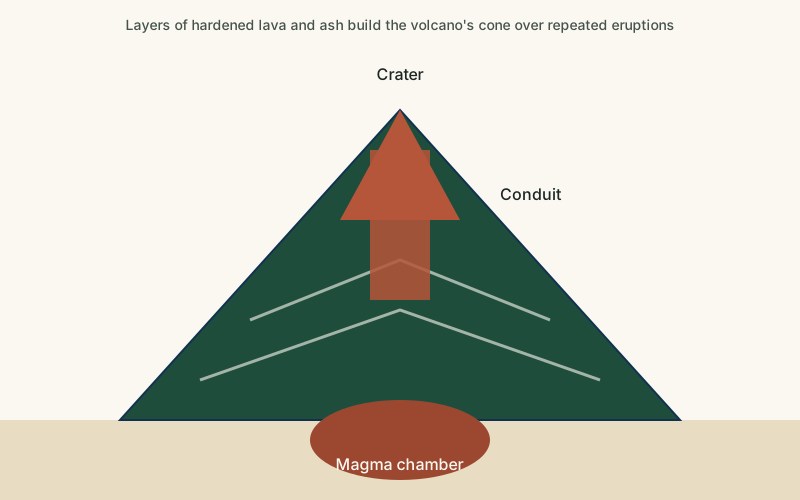
Volcanic islands are built almost entirely from igneous rock produced by eruptions, typically basalt from relatively fluid lava, along with ash and other erupted debris that compacts into rock over time. Continental islands, because they are simply detached pieces of a continent, can contain the full range of rock types found on that continent, including ancient granite, layered sedimentary rock, and metamorphic rock that may be far older than any volcanic island on Earth. This difference in material is often the clearest way to distinguish the two kinds of island in the field, since continental islands frequently show complex, folded, varied rock exposed over long geological histories, while volcanic islands show comparatively young, more uniform volcanic rock.
Climates and Environments
Both kinds of island occur across virtually every climate zone, from the tropical volcanic islands of the Pacific to the polar continental island of Greenland, so climate alone does not distinguish them. What does differ is the biological starting point: a newly emerged volcanic island is initially barren rock with no soil or life, and ecosystems develop slowly as seeds, insects, and birds arrive from elsewhere, while a continental island typically carries an existing ecosystem with it at the moment of separation, which then evolves somewhat independently of the mainland.
Real Examples
Hawaii, in the middle of the Pacific Ocean, is the textbook example of a hot-spot volcanic island chain, with the youngest and still-active volcanoes at one end and a trail of progressively older, eroded islands and seamounts extending away from the hot spot. Iceland combines hot-spot volcanism with its position directly on a divergent plate boundary, making it one of the most volcanically active islands on Earth. Japan sits along a volcanic arc built by subduction, its chain of islands tracing the boundary where the Pacific Plate descends beneath neighboring plates. Madagascar, by contrast, is a continental island that separated from Africa by rifting, and Great Britain is a continental island separated from mainland Europe largely by rising sea levels at the end of the last ice age.
How It Continues to Change
Volcanic islands continue to change as long as their associated hot spot or subduction zone remains active, growing larger with each eruption, while older islands in a hot-spot chain gradually erode, subside, and can eventually disappear beneath the ocean surface entirely, sometimes continuing on as coral atolls. Continental islands change far more slowly once separated, their coastlines reshaped mainly by ordinary erosion and sea-level fluctuation rather than by the creation of new rock, though rifting-formed continental islands can continue drifting away from their parent continent as the ocean floor between them continues to widen.
How It Differs From Similar Formations
Volcanic islands are easily confused with coral atolls, but an atoll is actually the final stage of an eroded, subsided volcanic island, with the original volcanic rock now submerged beneath a ring of coral reef and the central island gone entirely. Continental islands formed by rifting are closely related to rift valleys, since both begin with the same stretching and thinning of continental crust; a rift valley simply has not yet widened enough to flood and separate the land on either side into an island.
Common Misconceptions
Misconception: All islands are volcanic.
Reality: Many of the largest islands on Earth, including Greenland, Great Britain, and Madagascar, are continental islands made of ordinary continental rock, not volcanic material.
Misconception: An island near a continent must be a continental island, and one far out in the ocean must be volcanic.
Reality: Distance from the mainland is not a reliable indicator. What matters is the rock the island is made of and the process that isolated or built it, not its current location.
Misconception: Once a volcanic island forms, it stays the same size.
Reality: Volcanic islands continue to grow with each eruption and can also shrink or subside over time, especially after volcanic activity at that location ends.
Key Terms
- Hot Spot — A location where unusually hot material rises from deep within the mantle, producing volcanic activity independent of plate boundaries.
- Volcanic Arc — A curved chain of volcanoes that forms above a subduction zone, parallel to a plate boundary.
- Subduction — The process in which one tectonic plate is forced beneath another at a convergent boundary and sinks into the mantle.
- Continental Crust — The thicker, lower-density rock that makes up Earth's continents, distinct from the thinner oceanic crust.
- Oceanic Crust — The thinner, denser rock layer that forms the floor of the oceans, distinct from continental crust.
- Magma — Molten rock found beneath the Earth's surface, which becomes lava once it erupts above ground.
- Caldera — A large, bowl-shaped depression that forms when a volcano's summit collapses after a major eruption empties the magma chamber below it.