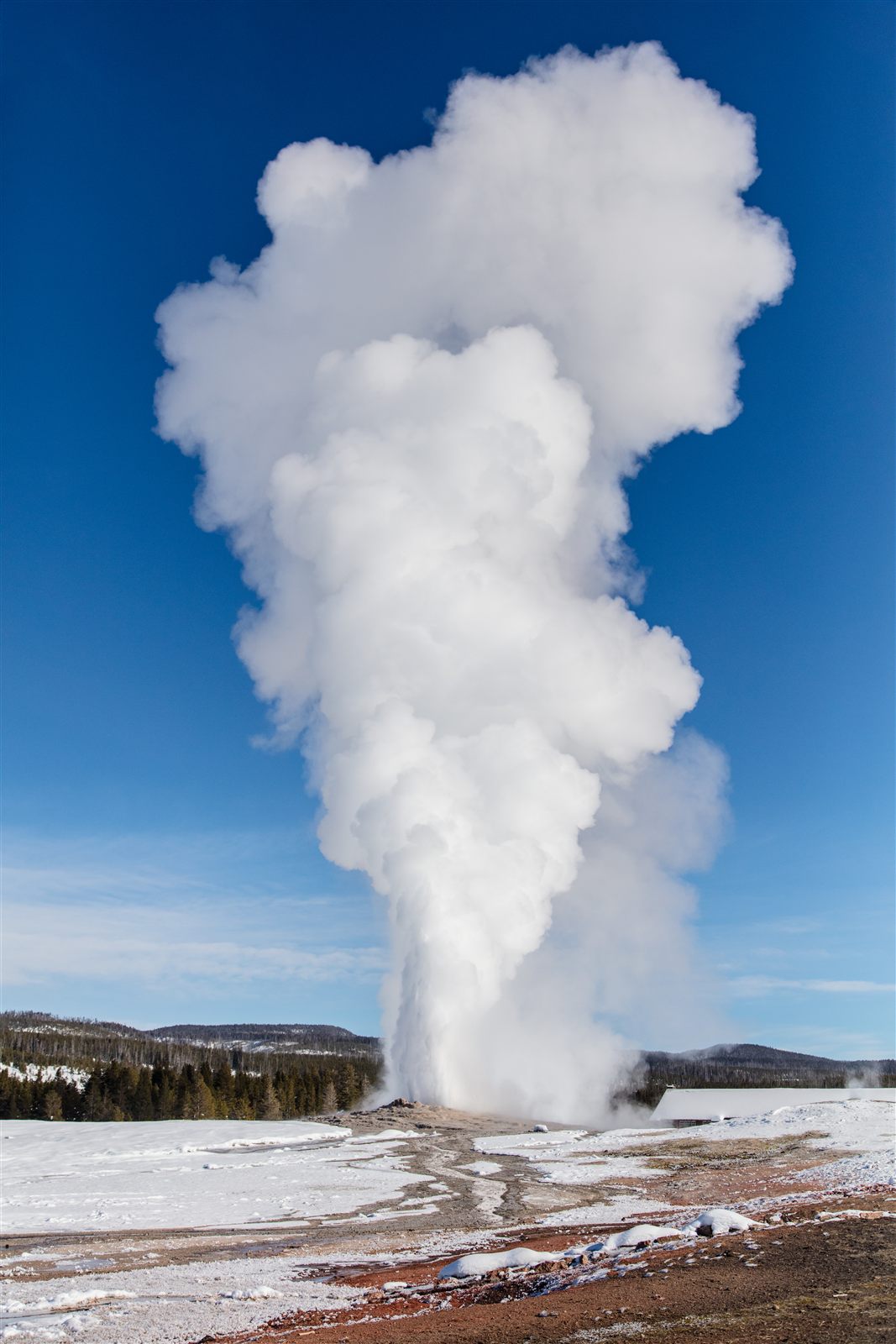
Definition
A geyser is a rare type of hot spring that periodically erupts, shooting a column of boiling water and steam into the air, while an ordinary hot spring simply discharges heated water at the surface without erupting. Both features form where groundwater comes into contact with heat from magma or hot rock close to the surface, but only a small number of hot springs worldwide have the specific underground plumbing needed to build up and release pressure in the rhythmic bursts that define a true geyser. Fewer than a thousand active geysers are known to exist on Earth, concentrated in a handful of geothermal regions.
How It Forms
Both hot springs and geysers depend on volcanic activity, or at least residual volcanic heat, interacting with circulating groundwater. The difference between a quietly flowing hot spring and an erupting geyser comes down to the shape and tightness of the underground channels the water travels through.
- Groundwater sinks toward a heat source.
Rain and snowmelt seep downward through cracked rock until they reach depths where magma, a shallow magma chamber, or still-cooling volcanic rock keeps the surrounding rock unusually hot. In most geothermal regions, this heat source lies several kilometers below the surface.
- Water is heated under pressure.
As the water sinks deeper, the weight of rock and water above it raises the pressure, which in turn raises the temperature at which water boils. This allows water trapped deep underground to reach temperatures well above the normal surface boiling point of 100°C (212°F) without actually turning to steam.
- The water rises back toward the surface.
Heated water is less dense than cooler water around it, so it rises slowly back toward the surface through cracks and conduits. In an ordinary hot spring, this plumbing is relatively open, so the heated water simply reaches the surface and flows out continuously or seeps out gently.
- In a geyser, pressure builds until it releases suddenly.
A true geyser needs a constriction — a narrow point in its underground plumbing that temporarily traps rising water. As trapped water is heated further, part of it flashes into steam, which rapidly expands and forces the water above it upward and out, triggering an eruption. Once enough pressure is released, the system resets and begins slowly refilling and reheating until the cycle repeats.
Formation Timescale
Geysers and hot springs are grouped under a rapid timescale because their individual eruptions and the daily cycling of their underground plumbing happen in minutes to hours, not millions of years — even though the geothermal heat source that powers them, and the volcanic system it belongs to, can remain active for hundreds of thousands of years. Eruption intervals vary enormously between geysers and are often irregular even at the same geyser, since small changes in underground mineral deposits, earthquakes, or groundwater levels can alter the timing of eruptions. Scientists who monitor well-known geysers describe their intervals as statistically predictable on average but not perfectly regular for any single eruption.
Main Characteristics
- Periodic eruptions: true geysers erupt at intervals ranging from minutes to many hours, distinguishing them from continuously flowing hot springs.
- Mineral deposits: dissolved silica or calcium carbonate carried up by hot water often precipitates around the vent, building distinctive formations called sinter or travertine.
- High water temperature: water discharged from geysers and hot springs is typically well above normal surface temperature, sometimes near boiling.
- Steam and gas emission: most geothermal features release some volcanic gases alongside water and steam, occasionally giving the area a sulfurous smell.
- Clustering in geothermal fields: geysers rarely occur alone and are usually found in fields containing many related hot springs, mud pots, and fumaroles.
Materials and Structures Involved
Geysers and hot springs do not deposit large rock formations the way lava or sediment do, but the mineral-rich water they discharge gradually builds distinctive surface deposits. Water passing through volcanic rock dissolves silica, which precipitates around a geyser's vent as it cools, forming a hard, glassy mineral called geyserite or siliceous sinter. Hot springs fed by water that has passed through limestone or other carbonate rock instead deposit travertine, a banded, often terraced mineral buildup. The surrounding rock itself is usually volcanic in origin — the same material, or the same underlying magma system, that supplies the heat driving the whole feature.
Climates and Environments
Geysers and hot springs are not defined by surface climate at all; what matters is the presence of a shallow heat source, almost always linked to volcanic activity, hot-spot activity, or tectonically thinned crust, combined with enough groundwater circulating through fractured rock nearby. As a result, active geothermal fields appear in climates ranging from the temperate forests surrounding Yellowstone to the near-arctic conditions of Iceland, and the visible plume of steam rising from a hot spring is often most dramatic in cold air, where it condenses immediately rather than dispersing.
Real Examples
Old Faithful, in Yellowstone National Park in the United States, is likely the most famous geyser in the world and has erupted with relative regularity for well over a century, though its average interval has shifted gradually over time. Geysir, in Iceland, is the geyser that gave the English word "geyser" its name and sits within a larger geothermal field that also includes the frequently erupting Strokkur. The Rotorua geothermal area in New Zealand hosts an extensive cluster of hot springs, mud pools, and geysers tied to the volcanism of the Taupo Volcanic Zone.
How It Continues to Change
Geothermal features change on surprisingly short timescales. Mineral deposits can gradually clog or reshape a geyser's underground plumbing, altering its eruption pattern over years or decades, and earthquakes can abruptly change or even permanently halt a geyser's activity by shifting the underground fractures it depends on. Some historically reliable geysers have gone dormant for long stretches and then reactivated, while others have stopped erupting altogether after nearby drilling or construction disturbed their plumbing, which is part of why many active geothermal fields are now carefully protected.
How It Differs From Similar Formations
Geysers are easily confused with ordinary hot springs, but the distinction is specific: a hot spring discharges heated water continuously or in a gentle, steady flow, while a true geyser requires a constriction in its plumbing that allows pressure to build and release in a true eruption. Geysers and hot springs are also related to, but distinct from, volcanoes themselves; a geyser field is powered by volcanic heat but does not erupt molten rock, and many active geothermal areas exist well away from any volcano capable of erupting lava.
Common Misconceptions
Misconception: All hot springs are geysers.
Reality: Most hot springs simply flow continuously without ever erupting. True geysers are a much rarer category that depends on a specific underground constriction capable of trapping and releasing pressure.
Misconception: A geyser's eruption timing is perfectly predictable.
Reality: Even well-studied geysers like Old Faithful erupt at a statistically average interval rather than a fixed one, and that average can shift over years as underground plumbing changes.
Misconception: Geysers require an active, erupting volcano nearby.
Reality: Geysers need a shallow source of heat, which is often residual heat from a volcanic system that is not currently erupting lava, or even heat tied to a hot spot or thinned crust rather than a classic eruptive volcano.
Key Terms
- Hydrothermal — Relating to hot water, typically water heated underground by volcanic or geothermal activity.
- Fumarole — An opening in the Earth's surface that emits steam and volcanic gases, often found in geothermal areas.
- Magma — Molten rock found beneath the Earth's surface, which becomes lava once it erupts above ground.
- Magma Chamber — A large underground pool of molten rock beneath a volcano that feeds eruptions.
- Groundwater — Water that exists beneath the Earth's surface in the cracks and pore spaces of soil and rock.
- Hot Spot — A location where unusually hot material rises from deep within the mantle, producing volcanic activity independent of plate boundaries.