Definition
A volcano is an opening in Earth's crust through which molten rock, ash, and gases escape from below the surface, along with the landform that often builds up around that opening over repeated eruptions. Not every volcano looks the same: the shape of a volcano is largely a record of how its magma behaves and how violently it has erupted over its history. Geologists group volcanoes into several broad types based on this shape and eruptive style, though many real volcanoes show features of more than one type and change character over their lifetimes.
How It Forms
The type a volcano becomes depends mainly on the composition and gas content of its magma. Thin, runny magma tends to flow long distances before cooling, building broad, gently sloped mountains, while thick, gas-rich magma tends to trap pressure until it erupts explosively, building steeper, more dangerous cones. The four types described below — shield volcanoes, stratovolcanoes, cinder cones, and calderas — represent the most common patterns, though volcanologists recognize additional, more localized forms as well.
- Shield volcanoes build up from fluid lava.
Shield volcanoes form where low-viscosity, basaltic lava erupts repeatedly and flows easily in all directions before solidifying, gradually building a broad, gently sloped dome that can look, from a distance, like a warrior's shield lying on the ground. Because the lava is fluid and relatively low in trapped gas, eruptions tend to be less explosive than at other volcano types, though they can still produce dramatic lava fountains. Hawaii's volcanoes are the best-known examples of this type.
- Stratovolcanoes alternate layers of lava and ash.
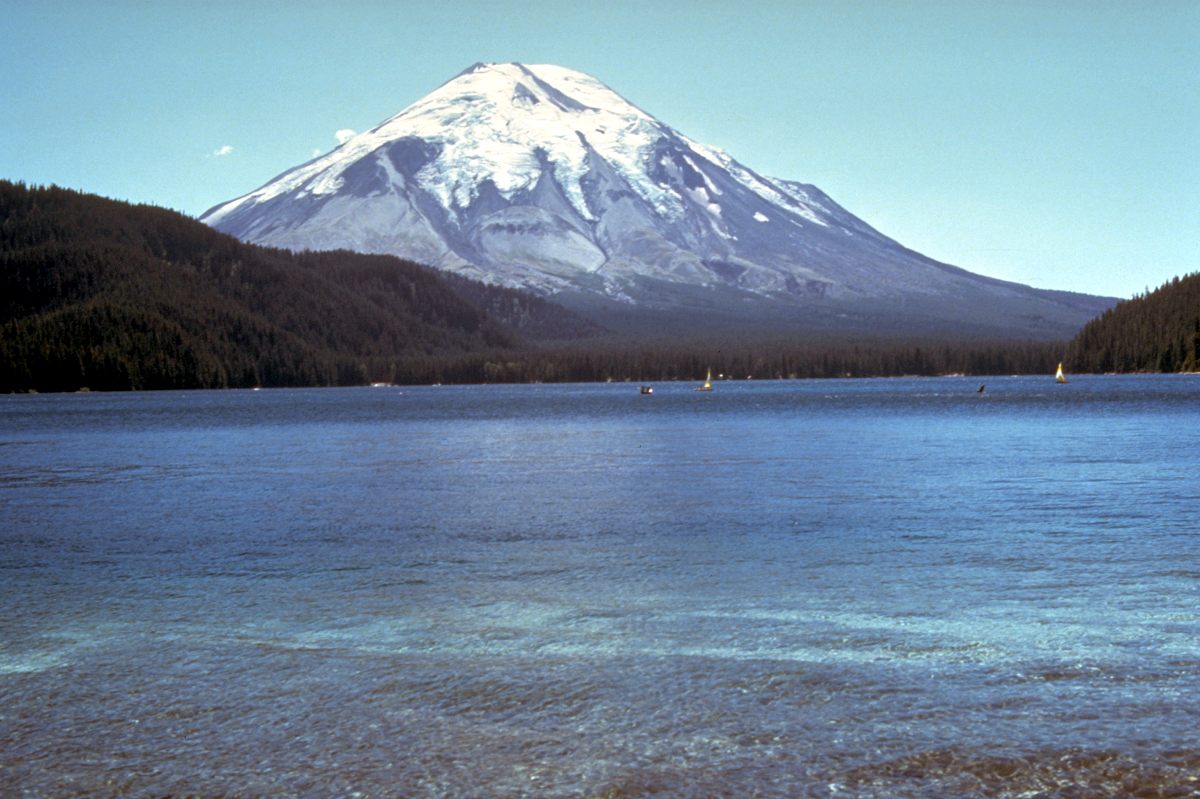
Stratovolcanoes, also called composite volcanoes, form where thicker, more gas-rich magma erupts in cycles that alternate between flowing lava and explosive bursts of ash and rock fragments. Each eruption adds another layer, building a tall, steep-sided, classically cone-shaped mountain over many thousands of eruptions. Because their magma traps gas more effectively than the fluid lava of shield volcanoes, stratovolcanoes are responsible for many of the most destructive eruptions in recorded history.
- Cinder cones form quickly from a single vent.
Cinder cones are small, steep, cone-shaped hills built when gas-charged lava is blasted into the air, cools into fragments of rock and ash as it falls, and piles up around a single vent. Unlike shield volcanoes and stratovolcanoes, which build up over many thousands of years, a cinder cone can form in a matter of months to a few years from a single eruptive episode, then usually never erupts again from the same vent.
- Calderas form when a volcano collapses inward.
A caldera is not a shape built up by eruption but one created by collapse. When an extremely large volume of magma is explosively erupted or drains from beneath a volcano, the ground above the emptied magma chamber can lose support and collapse inward, leaving a wide depression that is often many kilometers across — far larger than a typical crater at a volcano's summit. Some calderas, like Yellowstone's, mark eruptions powerful enough to be classified as supervolcanic.
Formation Timescale
How long it takes a volcano to form its characteristic shape varies enormously by type. A cinder cone can build its entire form during a single eruptive episode lasting weeks to a few years, then fall permanently dormant. A large shield volcano or stratovolcano, by contrast, is built from thousands of individual eruptions spread across tens of thousands to a few million years, with long quiet intervals between them. Caldera-forming collapses are typically sudden on a geological timescale — the collapse itself may take hours to days — even though the magma system beneath it may have been building toward that event for thousands of years. Because activity, dormancy, and collapse can each follow very different timelines, there is no single number that describes how long "a volcano" takes to form.
Main Characteristics
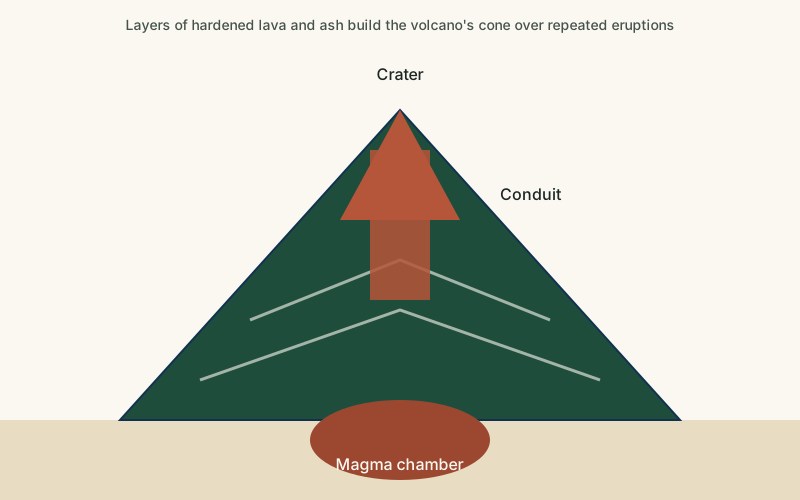
- Vent and crater: most active volcanoes have a central vent or crater at the summit through which material is erupted.
- Magma chamber: a reservoir of molten rock beneath the surface feeds eruptions and, when it empties quickly, can leave a caldera behind.
- Layered or fluid structure: a volcano's internal structure, layered ash and lava versus a single fluid mass, reflects its eruptive history.
- Slope angle: slope is a reliable clue to magma type, from the gentle rise of a shield volcano to the steep face of a stratovolcano.
- Association with plate boundaries or hot spots: most volcanoes cluster along tectonic plate boundaries or above isolated mantle hot spots.
Materials and Structures Involved
Volcanic landforms are built almost entirely from igneous rock, created when molten material cools and solidifies either at the surface, as lava, or underground. Basaltic lava, low in silica and highly fluid, is typical of shield volcanoes and produces smooth, ropy "pahoehoe" surfaces as well as rougher, blocky "a'a" lava. Stratovolcanoes and cinder cones typically involve more silica-rich magma, which erupts more explosively and produces large volumes of ash, pumice, and rock fragments collectively known as tephra, along with fast-moving pyroclastic flows of hot gas and ash in the most violent eruptions. Over time, these erupted materials can also weather into fertile volcanic soils, which is part of why many volcanic regions support dense agriculture despite the underlying hazard.
Climates and Environments
Volcanoes occur in essentially every climate zone, from the tropical volcanoes of Indonesia to the ice-covered volcanoes of Iceland and Antarctica, because their formation is driven by processes deep within the Earth rather than by surface climate. Climate does, however, affect how a volcano's surface evolves afterward: volcanoes in wet tropical climates are often quickly covered in dense vegetation between eruptions, while those in cold or arid regions may retain bare, exposed rock for far longer. Ice-capped volcanoes carry a particular hazard, since an eruption can rapidly melt snow and ice, triggering fast-moving mudflows called lahars that can travel far beyond the volcano itself.
Real Examples
Mauna Loa, in Hawaii, is one of the largest shield volcanoes on Earth, built from repeated fluid basaltic eruptions over roughly a million years. Mount Fuji, in Japan, is a classic stratovolcano whose symmetrical cone resulted from thousands of alternating lava and ash eruptions. Mount Vesuvius, in Italy, is a stratovolcano whose explosive eruption in 79 CE buried the Roman city of Pompeii in ash, preserving it for nearly two thousand years. The Yellowstone Caldera, in the western United States, formed after a series of exceptionally large eruptions emptied a vast magma chamber, and the area remains geothermally active today.
How It Continues to Change
Most volcanoes cycle between periods of eruption and dormancy that can last anywhere from years to tens of thousands of years, making it difficult to say with certainty whether a quiet volcano is truly extinct or simply resting. Shield volcanoes and stratovolcanoes continue to grow taller with each new eruption, while calderas can slowly refill with magma over time and, in rare cases, erupt again. Monitoring agencies track ground deformation, gas emissions, and small earthquakes beneath active volcanoes to try to anticipate renewed activity, though predicting the exact timing of an eruption remains one of the more uncertain areas of volcanology.
How It Differs From Similar Formations
Volcanoes are easy to confuse with ordinary mountains built by tectonic collision, but a mountain can rise without any volcanic material at all, while a volcano is specifically built, or collapsed, by erupted magma. Volcanic activity is also closely related to, but distinct from, the hydrothermal features described in how geysers and hot springs work: geysers and hot springs are usually powered by heat left over from nearby volcanic systems, but they involve circulating groundwater rather than erupting magma itself.
Common Misconceptions
Misconception: All volcanoes erupt explosively.
Reality: Eruption style depends heavily on magma composition. Fluid, low-gas basaltic magma, typical of shield volcanoes, often produces relatively gentle lava flows rather than violent explosions.
Misconception: A dormant volcano is the same as an extinct one.
Reality: Volcanoes can remain quiet for centuries or millennia and still erupt again. Scientists generally reserve "extinct" for volcanoes with no remaining magma supply, which can be difficult to confirm with certainty.
Misconception: Calderas are just large craters.
Reality: A crater typically forms directly from eruption at a vent, while a caldera forms afterward, when the ground collapses into a space left by a drained magma chamber, and is usually far larger than a crater.
Key Terms
- Stratovolcano — A steep-sided, cone-shaped volcano built from alternating layers of hardened lava, ash, and volcanic rock.
- Caldera — A large, bowl-shaped depression that forms when a volcano's summit collapses after a major eruption empties the magma chamber below it.
- Magma — Molten rock found beneath the Earth's surface, which becomes lava once it erupts above ground.
- Magma Chamber — A large underground pool of molten rock beneath a volcano that feeds eruptions.
- Lava — Molten rock that has reached the Earth's surface through a volcanic eruption.
- Crater — A bowl-shaped depression formed either by a volcanic eruption or by the impact of a meteorite.
- Hot Spot — A location where unusually hot material rises from deep within the mantle, producing volcanic activity independent of plate boundaries.
- Pyroclastic Flow — A fast-moving, extremely hot current of volcanic gas, ash, and rock fragments that flows down a volcano's slopes during an eruption.