Definition
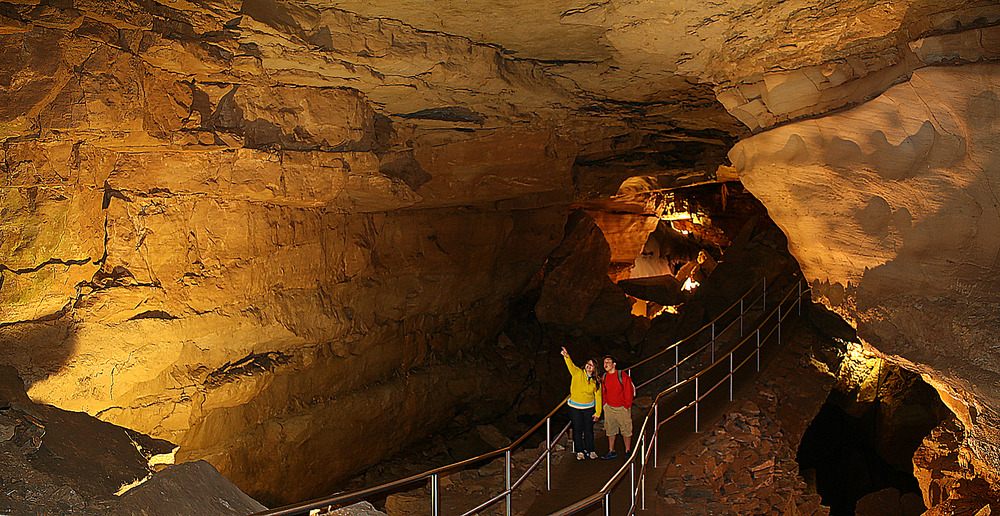
A cave is a natural underground void large enough for a person to enter, while a cavern specifically refers to a cave or chamber large enough to contain substantial open space, often decorated with mineral formations. Most of the world's largest and most well-known cave systems are solution caves, formed not by mechanical digging but by the slow chemical dissolving of soluble rock — usually limestone — by water. Other caves form through different processes, including lava tubes left behind by flowing volcanic lava and sea caves cut by wave action, but limestone solution caves are by far the most extensive and widespread type.
How It Forms
The formation of a typical limestone cave is a slow chemical process that plays out far below the surface, largely invisible until erosion or collapse eventually exposes it.
- Rainwater becomes slightly acidic.
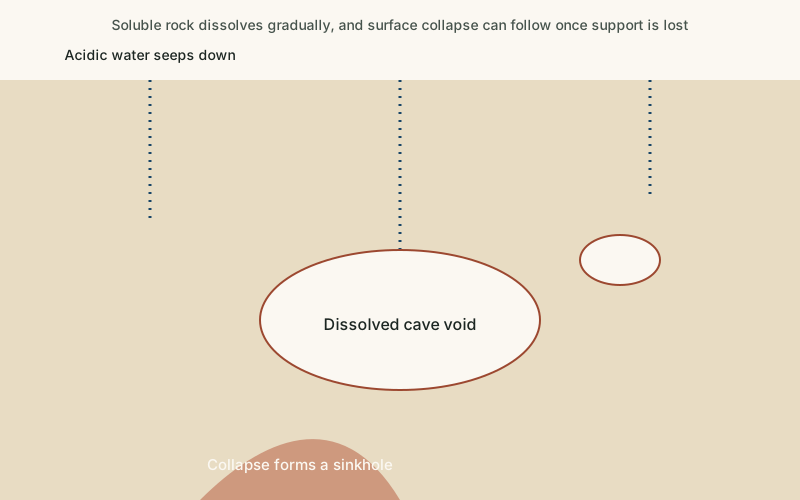
As rainwater passes through soil and decaying organic matter, it absorbs carbon dioxide and becomes a weak carbonic acid, mild enough to be harmless to touch but capable of slowly dissolving limestone over long periods.
- The acidic water seeps into cracks.
Limestone is naturally full of small cracks and joints. The slightly acidic water seeps into these openings and begins dissolving the rock along their surfaces, widening them very gradually.
- Passages widen along the water table.
Dissolution tends to concentrate near the water table, the underground boundary between saturated and unsaturated rock, where the chemical reaction is most active. Over time this carves out connected underground passages.
- Chambers and passages enlarge.
As dissolution continues over thousands of years, narrow channels widen into larger passages and chambers. Collapsed rock debris and further dissolution continue to reshape the space.
- Mineral formations develop.
Once a cave is partially air-filled, mineral-rich water dripping from the ceiling deposits tiny amounts of calcium carbonate as it evaporates, slowly building stalactites, stalagmites, and other formations over thousands of years.
Formation Timescale
Cave formation is a very slow process, typically unfolding over tens of thousands to hundreds of thousands of years for a substantial cave system, and the specific rate depends heavily on local rock chemistry, water flow, and climate. The mineral formations that decorate many caves, such as stalactites, often grow at a rate of a few centimeters per thousand years, though this rate varies widely and is not uniform even within a single cave. Because so much of this process happens out of sight and over very long periods, the exact age of most individual cave systems is difficult to pin down precisely and is usually expressed as a broad estimate rather than an exact figure.
Main Characteristics
- Dissolved rather than excavated walls: solution cave walls show smooth, rounded dissolution features rather than fractured or mechanically broken surfaces.
- Connection to a karst landscape: most large cave systems occur in regions with other karst features such as sinkholes and disappearing streams.
- Mineral formations (speleothems): stalactites, stalagmites, flowstone, and similar features form from the slow deposition of dissolved minerals.
- Stable underground climate: deep cave interiors often maintain a remarkably constant temperature and humidity year-round.
- Complex, branching passage networks: caves frequently form interconnected systems following old water pathways rather than a single simple tunnel.
Materials and Structures Involved
Limestone, composed mainly of calcium carbonate, is by far the most common rock in which solution caves form, because it dissolves relatively easily in mildly acidic water compared to most other rock types. Dolomite, a chemically similar carbonate rock, forms caves through the same basic process. Gypsum, a softer and even more soluble mineral, can form caves more quickly but these systems are often less stable. The mineral formations found inside many caves are built primarily from redeposited calcium carbonate, which crystallizes as calcite when mineral-rich water evaporates.
Climates and Environments
Solution caves are most extensively developed in regions with abundant rainfall and relatively warm temperatures, since more water movement and biological activity in the soil increase the acidity available to dissolve rock; tropical and temperate karst regions tend to have the most elaborate cave systems. Caves can also form in colder climates, though freezing can slow water movement and formation. Once formed, the deep interior of a cave is often insulated from surface climate conditions entirely, maintaining a stable internal environment regardless of the weather above.
Real Examples
Mammoth Cave in Kentucky is the longest known cave system in the world, with hundreds of kilometers of mapped passages dissolved from a thick limestone formation. Carlsbad Caverns in New Mexico formed through a somewhat different chemical pathway, involving sulfuric acid generated by rising hydrogen sulfide gas, and contains some of the largest known cave chambers in North America. Son Doong Cave in Vietnam contains passages large enough to hold skyscrapers and its own internal weather system, including clouds. Postojna Cave in Slovenia is one of the most studied show caves in Europe and has been visited for centuries.
How It Continues to Change
Active cave systems continue to change as water keeps moving through them: passages slowly widen, mineral formations continue growing drip by drip, and collapses occasionally reshape chambers. In regions where the water table has dropped, some caves that were once actively forming underwater become dry and effectively "fossilized," with their mineral formations continuing to grow only where moisture is still present. Human activity, including changes to groundwater levels and cave tourism, can also measurably affect the delicate internal conditions that shape ongoing formation.
Even small changes introduced by visitors, such as added heat, humidity, and carbon dioxide from breathing, can measurably shift the delicate chemical balance that governs mineral growth in a well-visited cave chamber, which is part of why many show caves carefully limit visitor numbers and monitor internal conditions. Cave researchers also study the chemical composition of mineral formations layer by layer, since they can preserve a detailed record of past climate conditions at the time each layer formed.
How It Differs From Similar Formations
Caves are closely related to karst landscapes in general, but karst is the broader regional term describing terrain shaped by dissolving rock, of which caves are just one feature among sinkholes, disappearing streams, and towers. Caves are also connected to sinkholes, which often form when a cave roof collapses or when surface material drains into an underground void — a sinkhole can be thought of as a cave system becoming visible at the surface. Lava tube caves, formed by flowing volcanic lava rather than dissolution, look superficially similar but form through an entirely different, much faster mechanical process.
Common Misconceptions
Misconception: All caves are formed by water physically carving through solid rock like a river canyon.
Reality: Most large caves form primarily through chemical dissolution, not mechanical erosion, though flowing water does help remove dissolved material and shape passages over time.
Misconception: Stalactites and stalagmites grow quickly enough to notice within a human lifetime.
Reality: Most mineral cave formations grow extremely slowly, often just centimeters per thousand years, which is why undisturbed formations are considered irreplaceable on human timescales.
Misconception: Caves are unchanging, static environments.
Reality: Active caves are still being shaped by water movement, mineral deposition, and occasional collapse, even though the changes are usually too slow to observe directly.
Key Terms
- Dissolution — The chemical process by which minerals, especially limestone, dissolve when exposed to slightly acidic water.
- Limestone — A sedimentary rock composed mainly of calcium carbonate, often formed from marine organism remains and highly soluble in acidic water.
- Karst — A landscape shaped by the dissolution of soluble rock, usually limestone, producing caves, sinkholes, and underground drainage.
- Groundwater — Water that exists beneath the Earth's surface in the cracks and pore spaces of soil and rock.
- Water Table — The upper surface of the saturated zone underground, below which all pore spaces are filled with water.
- Sinkhole — A depression or hole in the ground caused by the collapse of a surface layer into an underground void, often in karst terrain.
- Hydrothermal — Relating to hot water, typically water heated underground by volcanic or geothermal activity.