Definition
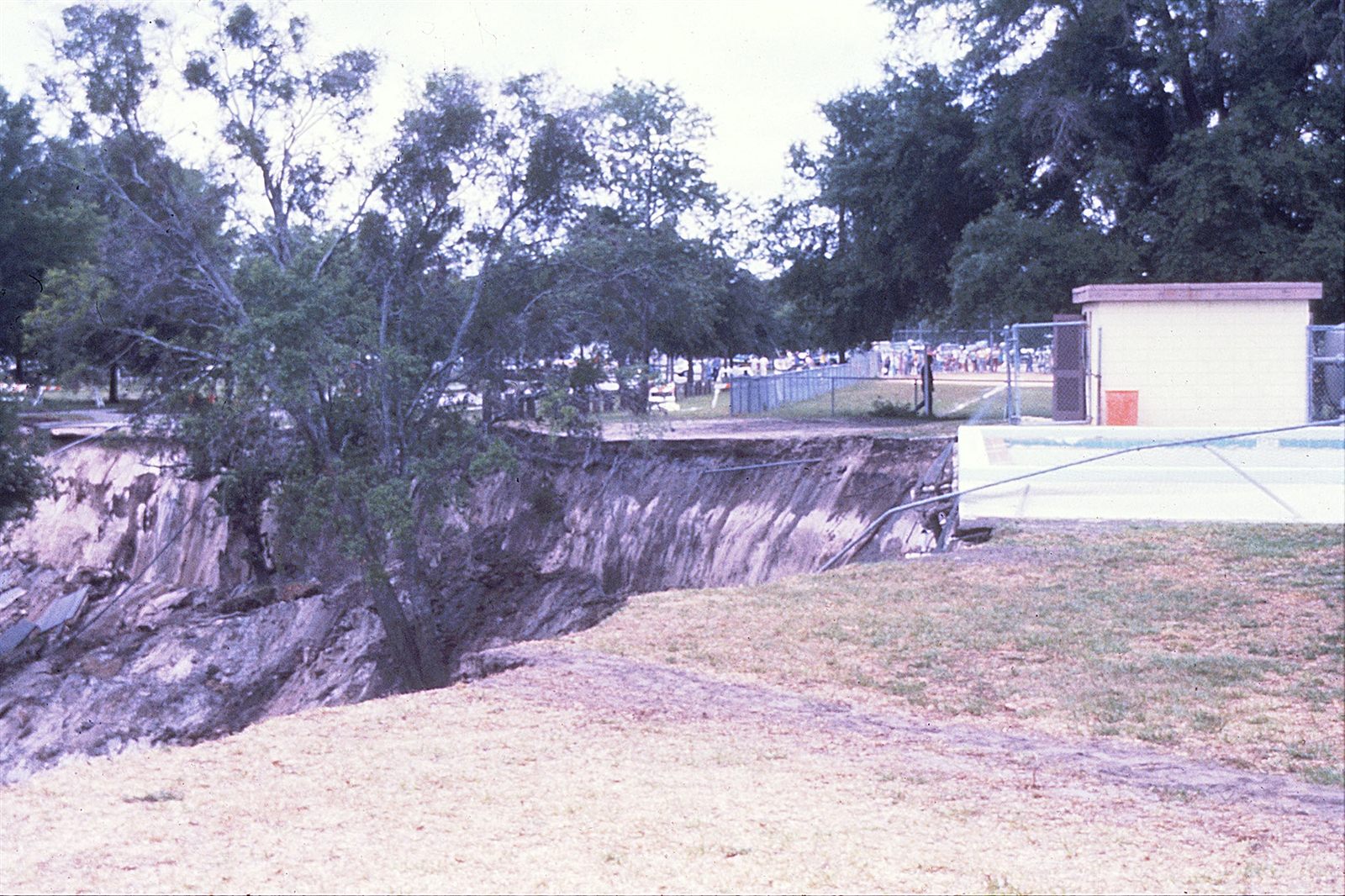
A sinkhole is a depression or hole in the ground that forms when a surface layer collapses into an underground void. Most sinkholes occur in karst regions, where soluble rock such as limestone, gypsum, or dolomite has been slowly dissolved by water over long periods, leaving behind unsupported cavities beneath a thinner layer of soil or rock. While the actual collapse that creates a visible sinkhole can happen suddenly, sometimes within seconds, the underground conditions that make it possible typically develop over a much longer period beforehand.
How It Forms
Sinkhole formation generally combines a slow, invisible preparation phase with a fast, visible collapse event.
- Water dissolves soluble rock underground.
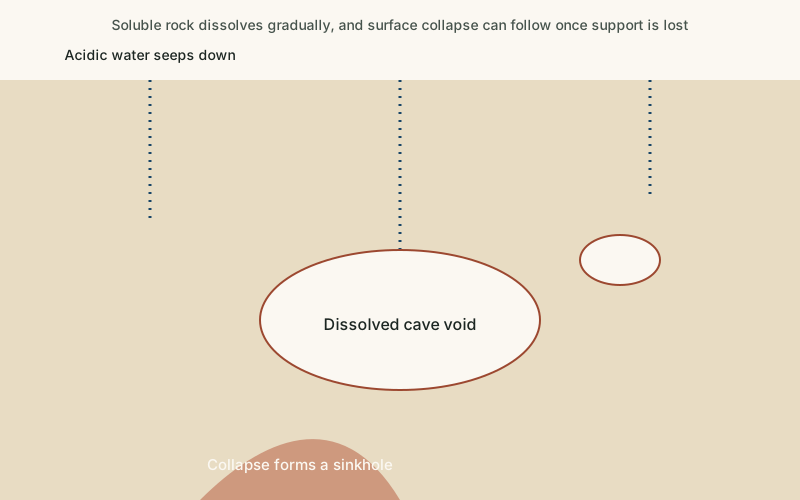
Slightly acidic groundwater gradually dissolves limestone or similar rock, widening cracks and creating underground voids, exactly as in typical cave formation.
- A void grows beneath a thinner surface layer.
As dissolution continues, the void can grow large enough that the remaining rock or soil layer above it becomes structurally unstable, even though the surface may show no visible sign of the problem.
- A trigger disturbs the balance.
Changes such as heavy rainfall, drought, groundwater pumping, or added surface weight can shift the pressure and moisture conditions enough to push an already unstable void toward collapse.
- The surface layer collapses.
Once support finally fails, the ground above the void drops suddenly, sometimes swallowing whatever was on the surface at the time and creating a sinkhole within seconds to minutes.
- The sinkhole may fill with water or debris.
Depending on local groundwater levels, a sinkhole may remain dry, partially fill with collapsed debris, or fill with water to form a sinkhole lake.
Formation Timescale
The underground dissolution that sets the stage for a sinkhole typically takes thousands of years, similar to ordinary cave formation, but the final collapse itself is often extremely rapid, sometimes occurring within seconds once the critical point is reached. This combination — a very slow setup followed by a very fast event — is part of why sinkholes can seem to appear suddenly and unpredictably, even though the underlying conditions were developing for a very long time beforehand. Predicting exactly when a specific vulnerable area will collapse remains difficult, since it depends on subsurface conditions that are not always visible or easily measured from the surface.
Main Characteristics
- Roughly circular or oval depression: most sinkholes have a rounded shape reflecting the void that collapsed beneath them.
- Association with karst terrain: sinkholes are concentrated in regions with extensive soluble rock and existing cave systems.
- Sudden appearance: the visible collapse event is often fast, even though the underlying cause developed slowly.
- Variable size: sinkholes range from small depressions a few meters across to enormous collapse features hundreds of meters wide.
- Potential connection to groundwater: many sinkholes intersect the local water table and can fill partially or completely with water.
Materials and Structures Involved
Sinkholes form most readily in regions underlain by limestone, dolomite, or gypsum, all of which dissolve relatively easily in slightly acidic water compared to most other rock types. The thickness and strength of the overlying soil or rock layer strongly influences both how long it takes for a void to become unstable and how dramatic the eventual collapse appears at the surface; thin, loose cover tends to collapse into cover-collapse sinkholes, while thicker, more cohesive material can slump more gradually into cover-subsidence sinkholes. Gypsum, being more soluble than limestone, can produce sinkholes considerably faster under similar conditions, though the resulting cavities are often less structurally stable as a result.
Climates and Environments
Sinkholes occur most frequently in humid temperate and tropical karst regions, where abundant rainfall and biological activity in the soil supply the acidity needed to dissolve underlying rock efficiently over time. Human activity, particularly groundwater pumping that lowers the water table and removes the buoyant support water had been providing to overlying material, has been directly linked to increased sinkhole activity in several regions, alongside natural triggers like heavy rainfall following drought.
Real Examples
The Great Blue Hole off the coast of Belize is a giant marine sinkhole that formed as a limestone cave system during a past period of lower sea level, later flooding as sea level rose. Sima Humboldt in Venezuela is an enormous forested sinkhole with its own partially isolated ecosystem at the bottom. Xiaozhai Tiankeng in China is one of the deepest known sinkholes in the world, formed through extensive underground river erosion and collapse. Devil's Sinkhole in Texas is a large single-chamber sinkhole that also serves as an important bat habitat. Together these examples show how varied sinkholes can be in scale and setting, from a submerged marine feature to a dry inland chamber.
How It Continues to Change
Sinkhole-prone regions remain geologically active below the surface even between visible collapse events, as groundwater continues to dissolve rock and create or enlarge underground voids. In areas with known karst risk, monitoring and geological surveys are often used to try to identify unusually vulnerable ground before a collapse occurs, though predicting the exact timing remains difficult. Existing sinkholes can also continue to change after formation, sometimes widening further as their edges continue to erode or collapse.
Geologists investigating sinkhole risk often combine surface surveys, historical records of past collapses, and subsurface techniques such as ground-penetrating radar to map where underground voids might already exist before they become visible. This kind of assessment is especially important before construction in known karst regions, since building loads can sometimes be the final factor that tips an already weakened void toward collapse.
How It Differs From Similar Formations
Sinkholes are closely tied to cave formation, since many sinkholes are essentially the surface expression of a cave system's roof finally failing. They are part of the broader karst landscape category, which also includes other dissolution features like disappearing streams and towers. Sinkholes differ from impact craters, which also produce roughly circular depressions but form through a sudden external collision rather than gradual internal dissolution and collapse.
Common Misconceptions
Misconception: Sinkholes can open up anywhere without warning.
Reality: Sinkholes are heavily concentrated in regions with soluble bedrock and existing karst features; areas without this underlying geology are far less susceptible.
Misconception: A sinkhole forms instantly, with no prior underground development.
Reality: The underground dissolution that creates a vulnerable void typically takes a very long time; only the final collapse itself happens quickly.
Misconception: All sinkholes are caused directly by human activity.
Reality: Sinkholes occur naturally in karst terrain, though human activities like groundwater pumping and construction can increase the likelihood or speed of a collapse in already vulnerable areas.
Key Terms
- Sinkhole — A depression or hole in the ground caused by the collapse of a surface layer into an underground void, often in karst terrain.
- Dissolution — The chemical process by which minerals, especially limestone, dissolve when exposed to slightly acidic water.
- Limestone — A sedimentary rock composed mainly of calcium carbonate, often formed from marine organism remains and highly soluble in acidic water.
- Karst — A landscape shaped by the dissolution of soluble rock, usually limestone, producing caves, sinkholes, and underground drainage.
- Groundwater — Water that exists beneath the Earth's surface in the cracks and pore spaces of soil and rock.
- Water Table — The upper surface of the saturated zone underground, below which all pore spaces are filled with water.