Definition
A karst landscape is terrain shaped primarily by the slow chemical dissolving of soluble bedrock, most often limestone, rather than by the more familiar mechanical wearing-away of rock by rivers, ice, or wind. Instead of carving valleys across the surface, water works its way into cracks and pore spaces in the rock itself, gradually dissolving it from the inside out. The result is a distinctive suite of features — caves, sinkholes, disappearing streams, and sometimes dramatic towers or pinnacles of resistant rock — that together define a karst region. The term comes from the Kras plateau in Slovenia, one of the first areas in Europe where this kind of terrain was studied in detail.
How It Forms
Karst develops through chemical weathering, specifically a reaction called dissolution, acting on rock that is soluble in slightly acidic water. Limestone, composed mostly of calcium carbonate, is by far the most common karst-forming rock, though dolomite and gypsum can produce similar landscapes. The process depends on three ingredients working together over very long periods: soluble rock, abundant water, and enough time for that water to move through the rock and carry dissolved material away.
- Rainwater becomes mildly acidic.
As rain falls through the atmosphere and filters through soil, it absorbs carbon dioxide and forms a weak carbonic acid. This acidity is subtle — nowhere near strong enough to dissolve most rock on contact — but limestone is unusually reactive to it, and the effect compounds over thousands of years of repeated exposure.
- Water finds weaknesses in the rock.
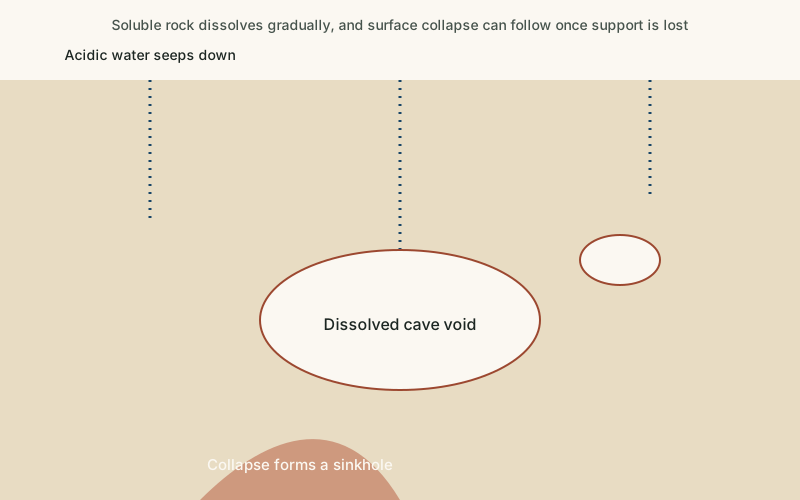
Limestone is rarely a single solid mass; it is crossed by joints, fractures, and bedding planes left over from how the rock originally formed. Slightly acidic water seeps into these weaknesses rather than running off the surface, and because dissolution works fastest where water moves fastest, the widest cracks widen more quickly than the narrow ones, concentrating the flow into fewer and fewer channels.
- Underground conduits and caves enlarge.
As cracks widen into channels large enough to carry significant groundwater flow, they can develop into true caves. Over time, interconnected networks of dissolved passages route most of a karst region's drainage underground, sometimes swallowing entire surface streams whole and carrying their water for kilometers before it resurfaces at a spring.
- The surface collapses and adjusts.
As underground voids grow large enough that the rock above can no longer support its own weight, the surface can subside gradually or collapse suddenly, forming sinkholes. In humid tropical regions with especially aggressive dissolution, the reverse pattern also appears: broad swaths of rock are dissolved away while isolated, more resistant blocks remain standing as steep towers.
Formation Timescale
Karst landscapes develop over very long timescales, typically hundreds of thousands to millions of years, because the chemical dissolution of limestone proceeds far more slowly than most people assume. Scientists estimate that a limestone surface in a temperate climate may lose only a fraction of a millimeter of material per year to dissolution, though rates vary considerably depending on rainfall, temperature, and the exact chemistry of the rock and water involved. Tropical karst, exposed to more rainfall and higher biological activity in the soil, is generally understood to dissolve faster than karst in cooler, drier climates, but precise comparisons are difficult because so many local factors are involved.
Main Characteristics
- Sinkholes: circular depressions where underground dissolution has caused the surface to subside or collapse.
- Disappearing streams: surface rivers that vanish into the ground partway along their course, rerouted through underground conduits.
- Extensive cave systems: interconnected underground passages formed as groundwater dissolves pathways through the rock.
- Springs: points where underground karst drainage re-emerges at the surface, sometimes far from where the water first disappeared.
- Limited surface drainage: karst regions often have far fewer visible streams and lakes than the rainfall they receive would normally produce.
- Towers and pinnacles: in humid tropical settings, isolated blocks of resistant limestone can remain standing after the surrounding rock has dissolved away.
Materials and Structures Involved
Limestone is the rock most strongly associated with karst, formed primarily from the compressed remains of marine organisms — shells, coral, and microscopic plankton — that lived and died in ancient seas, leaving behind calcium carbonate that later hardened into solid rock. Because limestone's chemical composition is fairly uniform and uniquely vulnerable to mildly acidic water, large limestone formations tend to develop broadly similar karst features worldwide, even in very different climates. Dolomite, a closely related carbonate rock, and gypsum, a softer and more rapidly soluble sulfate rock, can produce comparable landscapes, with gypsum karst sometimes forming features at a much faster pace because gypsum dissolves far more readily than limestone.
Climates and Environments
Karst can develop almost anywhere soluble rock is present, but climate strongly influences how dramatic and how fast the process unfolds. Humid temperate and tropical climates, with abundant rainfall and biologically active soils that add extra carbon dioxide to percolating water, tend to produce the most extensive and fastest-developing karst, including the towering peaks associated with tropical tower karst. Karst also occurs in drier and even cold climates, though more slowly and often with less dramatic surface expression, since there is less water available to drive dissolution. Vegetation and soil chemistry both play a meaningful role, which is one reason karst landscapes in similar rock but different climates can look strikingly different from one another.
Real Examples
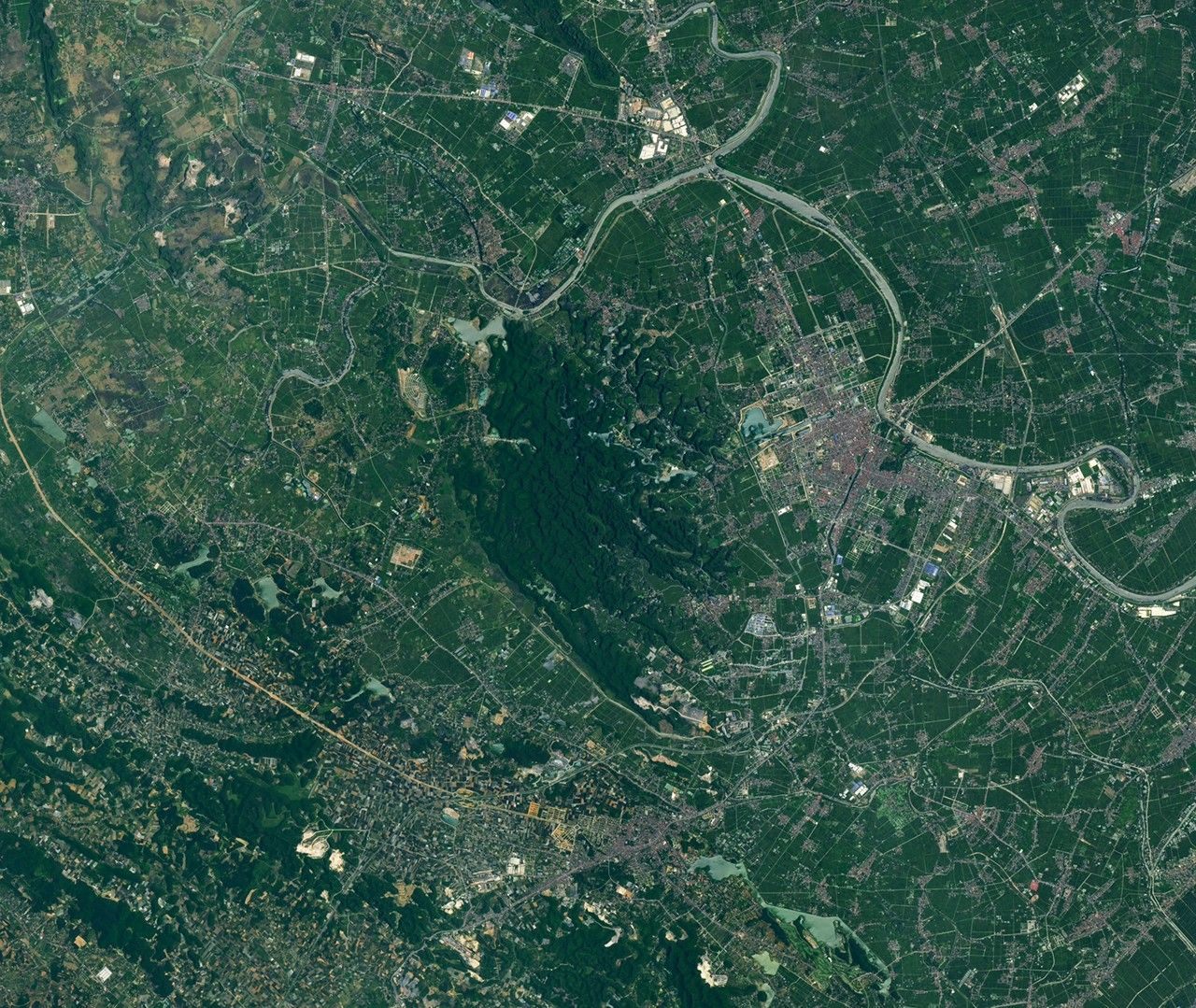
The karst towers around Guilin in southern China are among the most recognizable tropical karst landscapes in the world, rising abruptly from flat agricultural plains after millions of years of dissolution. The Kras Plateau in Slovenia, which gave karst terrain its name, remains an important reference site for studying how dissolution shapes a temperate limestone landscape. In North America, the limestone region around Mammoth Cave in Kentucky has produced one of the longest known cave systems on Earth. The limestone hills of Gunung Mulu in Borneo, Malaysia, host some of the largest known underground cave chambers, a reminder that karst dissolution can operate at an enormous scale given enough time.
How It Continues to Change
Karst landscapes continue to change today, often unpredictably. Dissolution never stops as long as water keeps moving through the rock, and underground cavities keep enlarging even when nothing is visible from the surface. This makes sinkhole collapse one of the more sudden hazards in natural landscape change: a cave roof that has been thinning for centuries can give way within seconds, sometimes with little or no surface warning. Human activity, including groundwater pumping and construction, can also accelerate these collapses by altering the balance of water and pressure that had kept a cavity stable.
How It Differs From Similar Formations
Karst is often confused with the caves found within it, but a cave is a single feature, while karst describes an entire landscape shaped by dissolution, which may include many caves alongside sinkholes, towers, and underground drainage. Karst is also related to, but broader than, sinkholes, which are just one of the surface features that karst dissolution can produce; not every karst region has dramatic sinkholes, and not every sinkhole occurs in classic karst terrain, since collapse can also occur over old mines or other artificial voids.
Common Misconceptions
Misconception: Karst landscapes only form in tropical regions.
Reality: Karst can develop anywhere soluble rock like limestone, dolomite, or gypsum is present and exposed to water, including temperate and even cold climates. Tropical karst tends to be more dramatic and develops faster, but it is not the only kind.
Misconception: A karst landscape is the same thing as a cave.
Reality: A cave is one feature that can form within karst terrain. Karst is the broader landscape, which may include sinkholes, disappearing streams, springs, and towers in addition to, or instead of, large caves.
Misconception: Limestone dissolves quickly enough to visibly change a landscape within a human lifetime.
Reality: Dissolution rates are generally very slow, often a fraction of a millimeter per year at the rock surface. The dramatic landscapes karst produces are the cumulative result of hundreds of thousands to millions of years of that slow process, not rapid change.
Key Terms
- Karst — A landscape shaped by the dissolution of soluble rock, usually limestone, producing caves, sinkholes, and underground drainage.
- Limestone — A sedimentary rock composed mainly of calcium carbonate, often formed from marine organism remains and highly soluble in acidic water.
- Dissolution — The chemical process by which minerals, especially limestone, dissolve when exposed to slightly acidic water.
- Chemical Weathering — The breakdown of rock through chemical reactions, such as the dissolving of limestone by slightly acidic water.
- Groundwater — Water that exists beneath the Earth's surface in the cracks and pore spaces of soil and rock.
- Water Table — The upper surface of the saturated zone underground, below which all pore spaces are filled with water.
- Sinkhole — A depression or hole in the ground caused by the collapse of a surface layer into an underground void, often in karst terrain.