Definition
An impact crater is a roughly circular depression formed when a meteoroid, asteroid, or comet strikes a planetary surface at extremely high speed. Unlike most landforms described on this site, impact craters are not built up gradually by everyday geological processes; they are created almost instantaneously, in a violent release of energy that can excavate, melt, and fracture rock across an area far larger than the object that caused it. More than 190 confirmed impact craters have been identified on Earth, though scientists estimate the true number created over the planet's history is far higher, since erosion, plate tectonics, and sediment cover have erased or hidden most of the evidence.
How It Forms
Impact craters form through meteorite impact, a process governed more by physics than by the slow chemical and mechanical processes that shape most other landforms. Because the energy involved is released in a fraction of a second, the stages of crater formation happen far faster than almost any other process described on this site.
- An object enters the atmosphere.
Smaller objects are often slowed or even destroyed by friction and pressure as they pass through the atmosphere, but sufficiently large or dense objects retain much of their extreme velocity — often tens of kilometers per second — all the way to the ground.
- The impact releases enormous energy almost instantly.
On contact, the object's kinetic energy converts into an intense shock wave that compresses, heats, and often melts or vaporizes both the impacting object and a large volume of surrounding rock, all within a fraction of a second.
- Rock is excavated and ejected.
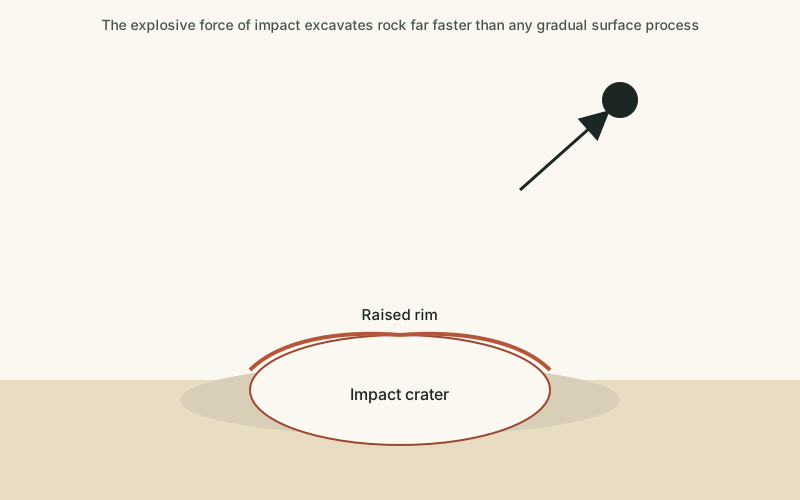
The shock wave forcefully excavates a bowl-shaped cavity, throwing shattered and melted rock outward and upward. Much of this ejected material falls back around the crater rim, while the finest material can be thrown far beyond the crater itself.
- The crater rebounds and stabilizes.
In larger impacts, the floor of the newly formed cavity can briefly rebound upward before settling, sometimes producing a central peak or ring within the crater. The final crater is typically far larger in diameter than the object that created it, since the surrounding rock is driven outward well beyond the point of direct contact.
Formation Timescale
The crater-forming impact itself happens on an extremely rapid timescale — the entire excavation process is generally understood to take place within seconds for crater sizes up to several kilometers wide, even though the object that caused it may have taken millions of years to reach Earth from elsewhere in the solar system. What takes far longer, and is much less precisely known, is how long a crater remains visible afterward; on Earth, active erosion, vegetation growth, and sediment deposition can soften or completely erase a crater's features within tens of thousands of years in wetter climates, while craters in very dry or geologically stable regions can remain recognizable for hundreds of millions of years.
Main Characteristics
- Circular or near-circular shape: most impact craters are roughly round regardless of the angle of impact, because the shock wave spreads outward in all directions.
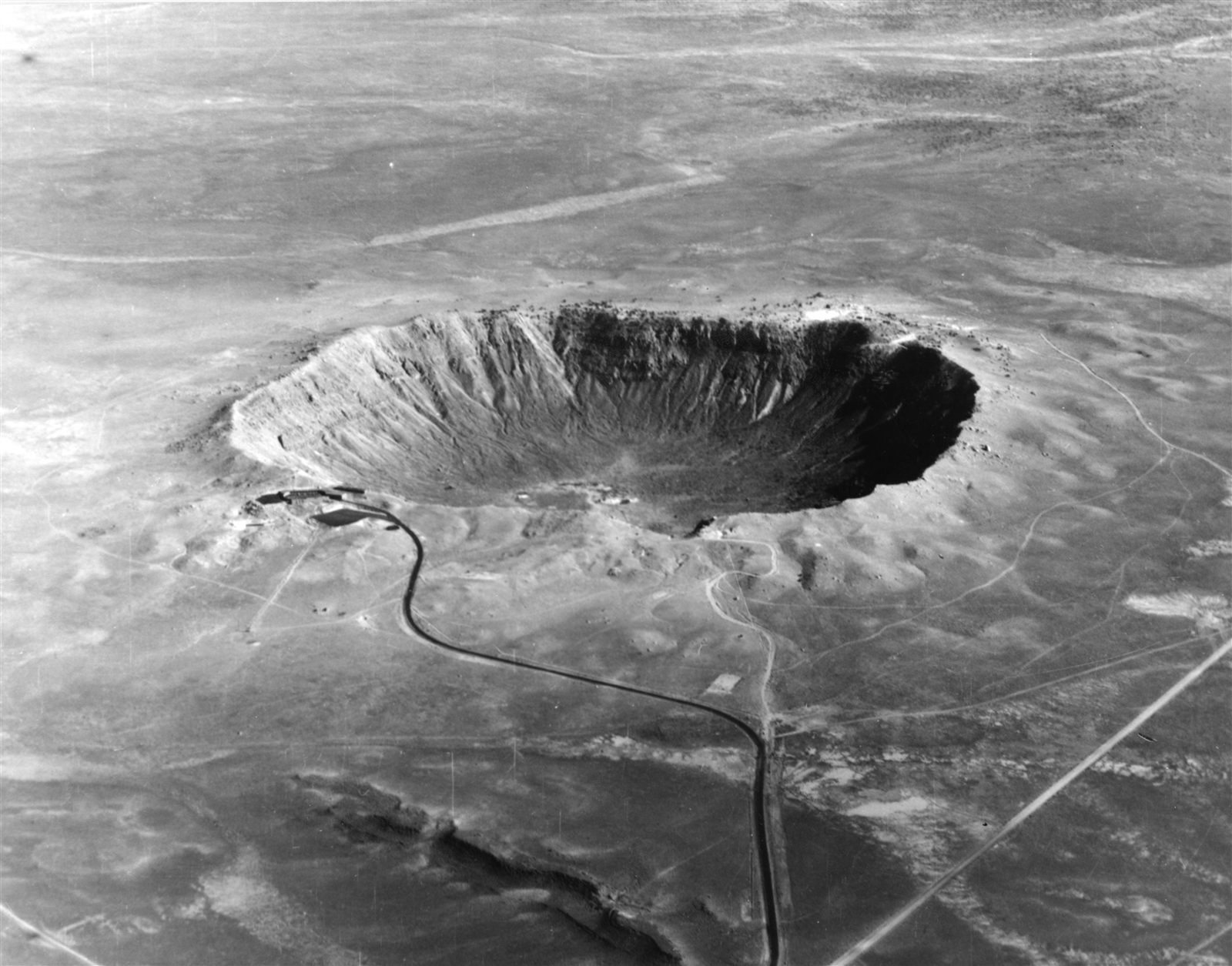
- Raised rim: material excavated from the crater is pushed outward and upward, often forming an elevated ridge around the depression.
- Shattered and melted rock: impacts can fracture rock well beyond the visible crater and, in larger events, melt rock into distinctive impact glass.
- Ejecta blanket: a layer of debris thrown out during the impact often surrounds the crater, sometimes extending many crater-widths beyond the rim.
- Central peak or ring (in larger craters): sufficiently large impacts can produce a raised structure near the crater's center as the floor rebounds after excavation.
Materials and Structures Involved
The rock within and around an impact crater is often dramatically altered by the extreme pressures and temperatures of the impact itself, producing distinctive materials rarely found elsewhere. Shocked quartz and other minerals that have been physically deformed by the shock wave, along with impact glass formed when rock briefly melts and then cools rapidly, are among the clearest evidence scientists use to confirm that a given depression was actually created by an impact rather than by volcanic or erosional processes. Beyond these unusual materials, the bulk of a crater's structure is simply the local bedrock, shattered and rearranged rather than replaced.
Climates and Environments
Impact craters can form in any climate or environment, since the process depends entirely on an object arriving from space rather than on local surface conditions. However, climate strongly affects how long a crater survives afterward: craters in hot, dry desert and plains environments with limited vegetation and slow erosion, such as parts of Australia and the Arabian Peninsula, tend to remain visible far longer than craters in humid, vegetated regions, where rainfall, plant growth, and sediment accumulation can obscure a crater's shape within a comparatively short span of geological time.
Real Examples
Meteor Crater, also known as Barringer Crater, in Arizona in the United States, is one of the best-preserved impact craters on Earth, largely because the arid desert climate has limited erosion since it formed roughly 50,000 years ago. The Vredefort Dome, in South Africa, represents the deeply eroded remnant of one of the largest confirmed impact structures on the planet, formed roughly two billion years ago. The Chicxulub crater, buried beneath the Yucatan Peninsula in Mexico, formed around 66 million years ago and is widely associated by scientists with the mass extinction event that ended the age of dinosaurs. Wolfe Creek Crater, in a remote part of Western Australia, remains strikingly well preserved thanks to the region's dry climate and slow erosion.
How It Continues to Change
Once formed, an impact crater generally does not grow or deepen the way many other landforms do; instead, the dominant process going forward is gradual degradation. Wind, rain, and occasional flash flooding slowly wear down the raised rim and fill the depression with sediment, while vegetation, where present, can accelerate this infilling. On a much longer timescale, plate tectonics can fold, bury, or even completely destroy evidence of ancient craters, which is part of why scientists believe Earth's visible crater record represents only a small fraction of all the impacts that have actually occurred over its history.
How It Differs From Similar Formations
Impact craters are sometimes confused with volcanic calderas, but the two form through essentially opposite processes: an impact crater is excavated from outside by an object striking the surface, while a caldera collapses from within after a volcanic eruption empties the magma chamber beneath it. Impact craters are also distinct from sinkholes, which are circular depressions caused by the slow underground collapse of soluble rock rather than a sudden external impact; both can look similar from above, but their internal rock structure and the speed at which they form are entirely different.
Common Misconceptions
Misconception: Impact craters are rare events that have barely affected Earth's surface.
Reality: Scientists estimate that far more impacts have struck Earth over its history than the roughly 190 confirmed craters currently identified, since erosion, vegetation, sediment cover, and plate tectonics have erased or hidden most of the evidence.
Misconception: A crater's size directly matches the size of the object that caused it.
Reality: The final crater is typically many times wider than the object itself, because the impact's energy excavates and displaces a much larger volume of surrounding rock than the object's own dimensions would suggest.
Misconception: All round depressions on a planet's surface are impact craters.
Reality: Volcanic calderas, sinkholes, and some other landforms can also produce circular depressions. Scientists confirm an impact origin by looking for specific evidence such as shocked minerals, impact glass, or a surrounding ejecta blanket.
Key Terms
- Crater — A bowl-shaped depression formed either by a volcanic eruption or by the impact of a meteorite.
- Erosion — The wearing away and removal of rock, soil, or sediment by natural forces such as water, wind, or ice.
- Weathering — The breakdown of rock in place, through physical, chemical, or biological processes, without the material being transported away.
- Bedrock — The solid rock that lies beneath soil, sediment, and other loose surface material.
- Sediment — Solid material — fragments of rock, mineral grains, or organic matter — that is transported and deposited by water, wind, or ice.
- Sedimentary Rock — Rock formed from the compaction and cementation of accumulated sediment over time.