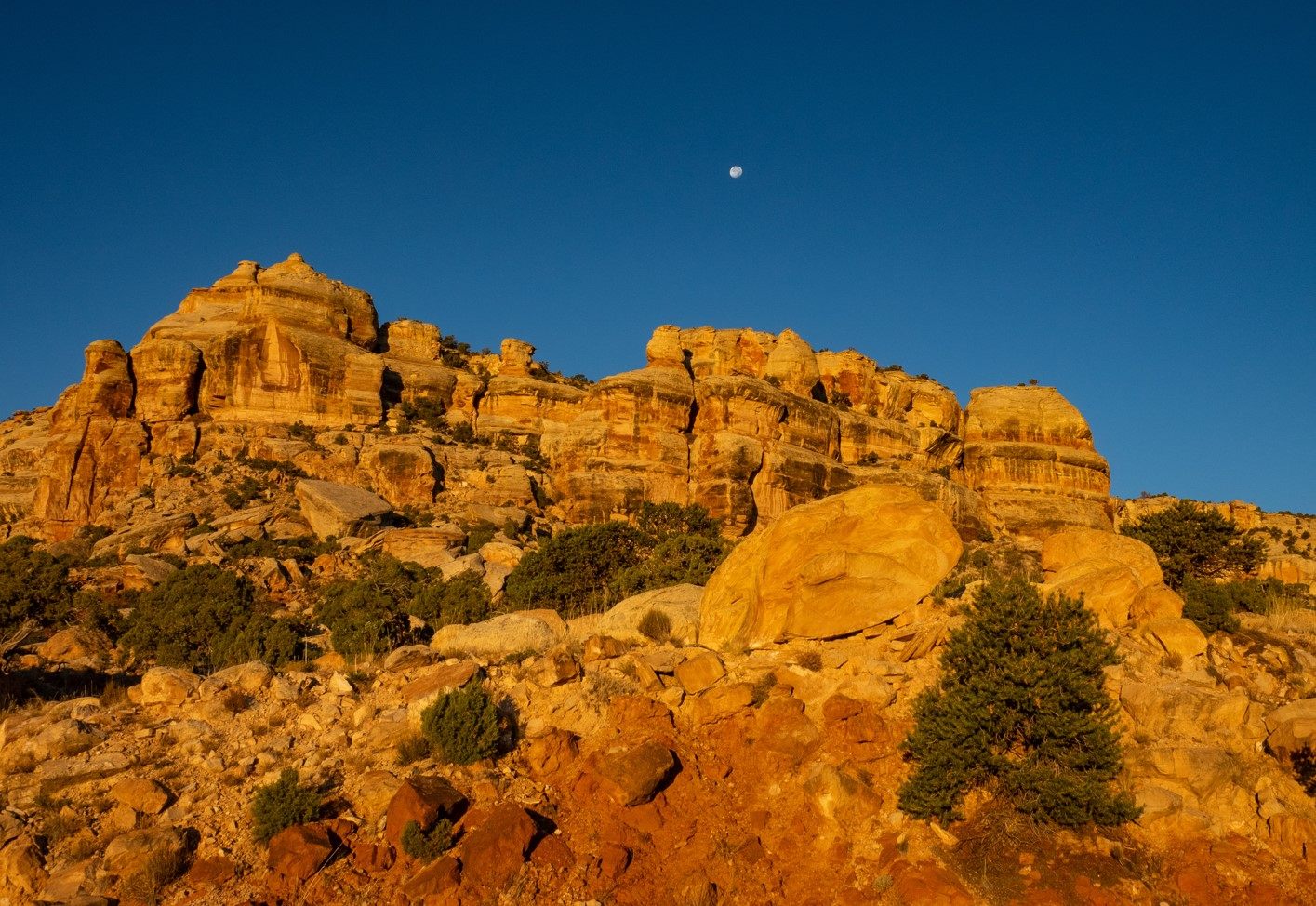
Definition
Every natural landscape takes some amount of time to form, but that amount of time varies more than almost any other single fact about landforms, from a cliff face that collapses in seconds to a mountain range that has been rising for tens of millions of years and is still not finished. This article looks at why that range is so enormous, and what makes a particular landscape fall toward the fast or slow end of it, rather than describing any single landform in detail.
How It Forms
Four factors, acting together, explain most of the difference between a landscape that forms within a human lifetime and one that takes geological ages: the strength of the rock involved, the strength of the force acting on it, whether that force acts continuously or only occasionally, and how much material actually has to be moved or rearranged to produce the finished landform.
- Rock strength sets a baseline speed limit.
Soft, weak rock such as shale, unconsolidated sediment, or salt erodes or collapses far more easily than hard, resistant rock such as granite, basalt, or well-cemented sandstone. A landscape carved into weak rock can take shape in centuries; the same landscape carved into resistant rock by the same forces might take a million years or more to reach a similar result.
- The strength of the driving force matters as much as the rock.
A landscape shaped by a sudden, high-energy event, such as a flash flood, a volcanic eruption, or a meteorite impact, can form in minutes to years, because enormous energy is delivered all at once. A landscape shaped by gradual tectonic uplift or slow chemical weathering, where comparatively little energy acts at any given moment, inevitably takes far longer to produce a comparable amount of change.
- Continuous processes compound; occasional ones do not.
Some landscapes form through forces that operate essentially nonstop, such as a river continuously carving its bed or a tectonic plate continuously pushing against its neighbor. These processes compound steadily over time. Others depend on occasional, widely spaced events, such as individual large storms or earthquakes, and most of the elapsed time between those events produces little visible change at all, which can make the overall process look even slower than its active moments would suggest.
- The scale of change needed affects the total time.
Lifting an entire mountain range thousands of meters, or carving a canyon a mile deep through resistant rock, requires moving or rearranging an immense volume of material, which necessarily takes longer than producing a smaller landform of similar type. Scale alone, independent of the process involved, is one of the simplest reasons two landscapes built by the same general mechanism can still take very different amounts of time.
Formation Timescale
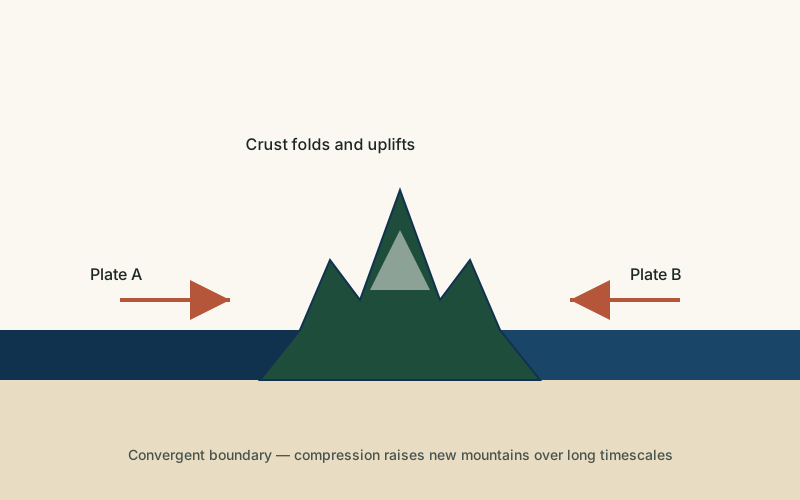
Comparing a few real landscapes shows just how wide this range can be. A rockfall or a cliff collapse can reshape a slope within seconds, driven by gravity acting on rock that has already been weakened by other, slower processes. A volcanic island such as Surtsey, off the coast of Iceland, emerged from the ocean within a span of days to a few years during an eruption in the 1960s. A canyon such as the Grand Canyon has been cut by the Colorado River over roughly five to six million years, a figure that is still debated and refined as research continues, since the river's course and the rate of uplift of the surrounding plateau both changed over that period. A mountain range such as the Himalayas has been rising for roughly the last 50 million years and, because the tectonic collision driving it has not stopped, is still actively gaining height today even as erosion wears it down. At the far end of the scale, the opening and closing of entire ocean basins as supercontinents assemble and break apart unfolds over hundreds of millions of years. None of these figures should be read as precise or universally fixed; estimated ages for slow geological processes are typically ranges, not exact numbers, and they are revised as new evidence becomes available.
Main Characteristics
- Fast-forming landscapes: typically driven by a single high-energy event, often involve weak or already-weakened rock, and show most of their change within a short, identifiable period.
- Slow-forming landscapes: typically driven by continuous, low-energy forces acting on resistant rock, with change accumulating so gradually that it is imperceptible on human timescales.
- Mixed-speed landscapes: many landforms combine both, such as a canyon where gradual river erosion is punctuated by occasional dramatic rockfalls or floods that remove large amounts of material at once.
- Reversibility: some fast-forming landscapes, such as sand dunes, can be substantially remade within years, while slow-forming landscapes built from solid rock essentially cannot be undone on any humanly meaningful timescale.
- Ongoing uncertainty: because slow processes cannot be observed directly from start to finish, their total duration is almost always an estimate built from indirect evidence, and that estimate is regularly refined as techniques improve.
Materials and Structures Involved
The rock or sediment involved in a landscape is one of the strongest predictors of how long it will take to form. Granite and basalt, both dense and chemically stable, resist both mechanical erosion and chemical weathering, so landscapes carved into them tend to take longer than landscapes of similar size carved into limestone, shale, or salt, all of which are far more easily dissolved or broken apart. Unconsolidated material such as volcanic ash, sand, or glacial till can be reshaped essentially overnight by wind, water, or further eruption, which is part of why young volcanic landscapes and sand dune fields can change so quickly compared with landscapes cut into ancient bedrock.
Climates and Environments
Climate strongly influences how fast surface processes can reshape a landscape, even when the underlying rock stays the same. Chemical weathering, which dissolves or breaks down rock through reactions with water and air, proceeds much faster in warm, wet, tropical conditions than in cold or arid ones, which is part of why limestone landscapes erode into dramatic karst terrain relatively quickly in the tropics but can remain comparatively intact for far longer in a cold, dry climate. Glacial and periglacial environments introduce their own rapid mechanisms, such as frost wedging and glacial plucking, that can break apart even hard rock surprisingly quickly once ice becomes involved. Because climate itself changes over geological time, often cycling between ice ages and warmer periods, the rate at which a given landscape has formed has frequently sped up and slowed down repeatedly over its own history.
Real Examples
The Grand Canyon illustrates a landscape shaped by a continuous process, river erosion, working over several million years, slowed and sped up at different points as regional uplift and climate shifted. The Himalayas illustrate the opposite end of continuous, tectonic-driven formation, still actively rising after tens of millions of years with no clear end in sight. Surtsey illustrates the fastest end of the spectrum, an entirely new island built in a matter of years by a single sustained volcanic eruption. The Ries Crater in Europe illustrates an even faster extreme: it was excavated in moments by a meteorite impact roughly 15 million years ago, then slowly softened and partly filled by ordinary erosion and sediment deposition over the long span of time since.
How It Continues to Change
Formation speed is not a fixed property of a landscape type; it depends on the specific conditions at a specific place and time, and those conditions change. A river's erosion rate speeds up after an unusually wet period and slows during drought. A mountain range's net height depends on the ongoing balance between uplift, which continues as long as the driving tectonic collision continues, and erosion, which can accelerate or slow with shifts in climate and vegetation cover. Even the slowest geological processes are still active today, which is why scientists continue to study currently forming landscapes, such as active mountain ranges and young volcanic islands, to better understand how similar, now-ancient landscapes originally took shape.
How It Differs From Similar Formations
It helps to compare opposite ends of this range directly. Impact craters form about as fast as any landscape on this site, excavated essentially instantly by a single collision, with all of the subsequent softening by erosion happening far more slowly afterward. Mountains sit at the opposite extreme, built by tectonic forces that operate continuously over tens of millions of years and are, in many active ranges, still not finished. Comparing the two makes clear that formation speed depends far more on the mechanism and the forces involved than on the final size or dramatic appearance of the resulting landscape.
Common Misconceptions
Misconception: Every impressive natural landscape took millions of years to form.
Reality: Some of the most dramatic landscapes on Earth, including fresh impact craters and newly emerged volcanic islands, formed within years or even moments. Visual drama and formation time are not reliably connected.
Misconception: A bigger landform always took longer to form than a smaller one.
Reality: Scale is only one factor among several. A small landform cut into resistant rock by a weak process can take far longer than a much larger landform produced quickly by an exceptionally powerful event.
Misconception: Once scientists state an age for a slow-forming landscape, that number is settled.
Reality: Ages for processes that unfold over hundreds of thousands to millions of years are almost always estimates built from indirect evidence, and they are revised, sometimes substantially, as research methods improve.
Key Terms
- Plate Tectonics — The scientific theory describing how Earth's rigid outer shell is divided into plates that move slowly over the mantle, shaping continents and ocean basins.
- Orogeny — The geological process of mountain building, typically driven by the collision or convergence of tectonic plates.
- Erosion — The wearing away and removal of rock, soil, or sediment by natural forces such as water, wind, or ice.
- Weathering — The breakdown of rock in place, through physical, chemical, or biological processes, without the material being transported away.
- Chemical Weathering — The breakdown of rock through chemical reactions, such as the dissolving of limestone by slightly acidic water.
- Isostasy — The gravitational balance between the Earth's crust and the denser mantle beneath it, which causes crust to rise or sink as weight is added or removed.