Definition
A salt flat is a flat, salt-crusted expanse of land formed where a shallow body of water, often an ancient lake, has evaporated repeatedly, leaving behind thick layers of dissolved minerals. Rather than being covered in ordinary sand or soil, the surface of a salt flat is made of crystallized salts, most commonly sodium chloride or various other evaporite minerals, sometimes forming a surface so flat and hard that it is used for land speed record attempts. Salt flats represent one of the most visually distinctive landforms produced by evaporation rather than erosion.
How It Forms
Salt flats form through deposition, specifically the precipitation of dissolved minerals left behind as water evaporates, combined with the longer-term chemical weathering that originally released those minerals from surrounding rock. The process requires a closed basin — one with no outlet to the sea — so that water entering the basin has nowhere to go except back into the atmosphere.
- Water collects in a closed basin.
Salt flats form in topographic basins with no drainage outlet, often in the lowest point of a desert valley surrounded by higher ground. Rain and meltwater flowing into the basin accumulate there instead of draining away to a river or ocean.
- Rivers and groundwater carry dissolved minerals into the basin.
As water travels toward the basin, it dissolves small amounts of mineral salts from the rock and soil it passes through. Over thousands of years, repeated inflow steadily adds more dissolved mineral content to the basin even as water itself evaporates away.
- Evaporation concentrates the dissolved minerals.
In arid climates, evaporation removes water from the basin far faster than rainfall can replace it. Because evaporation removes only water, not the minerals dissolved within it, each cycle of filling and drying leaves the remaining water increasingly concentrated with salts.
- Minerals crystallize into a solid crust.
Once the dissolved minerals reach a high enough concentration, they can no longer stay dissolved and begin to crystallize out of solution, settling onto the basin floor as a solid layer. Repeated over many evaporation cycles, these thin layers accumulate into the thick salt crust that defines a mature salt flat.
Formation Timescale
Salt flats are generally understood to form on a medium timescale, with substantial salt deposits typically requiring thousands to tens of thousands of years to accumulate, though this varies considerably depending on how much dissolved mineral enters the basin and how reliably it evaporates. Some of the thickest known salt flat deposits represent many repeated wet-and-dry cycles stretching back over longer periods still, and researchers studying salt flat sediment layers often use them as a record of past climate change, since thicker or thinner salt layers can reflect wetter or drier periods long before written history.
Main Characteristics
- Extremely flat surface: salt flats are among the flattest natural surfaces on Earth, varying by only centimeters in elevation across vast areas.
- Bright, reflective crust: the crystallized salt surface is usually pale white or light-colored and highly reflective in sunlight.
- Polygonal crust patterns: repeated wetting and drying often cracks the salt crust into distinctive hexagonal or polygonal shapes.
- Minimal vegetation: the high salt content and arid surrounding climate make salt flats largely inhospitable to plant life.
- Underlying brine: many salt flats retain a layer of concentrated saltwater just beneath the dry crust, which can rise to the surface after rain.
Materials and Structures Involved
The crust of a salt flat is made of evaporite minerals, chemical deposits that form when mineral-saturated water evaporates and leaves solid material behind. The most common evaporite in salt flats is halite, ordinary sodium chloride, though many salt flats also contain gypsum, borax, or other dissolved minerals depending on the chemistry of the rocks surrounding the basin. In some salt flats, these additional minerals, including lithium-bearing compounds, have become commercially significant, since the same evaporation process that builds the salt crust can also concentrate valuable minerals within the underlying brine.
Climates and Environments
Salt flats require an arid climate, where evaporation substantially exceeds rainfall over the long term; without this imbalance, a closed basin would simply remain a permanent lake rather than drying into a salt crust. They are almost always found in desert environments within closed, interior drainage basins, often at relatively high elevation on continental plateaus where surrounding mountains prevent water from reaching the sea. Because they depend on this specific combination of aridity and closed drainage, salt flats tend to occur in distinct, isolated regions rather than forming continuously across a wider desert landscape.
Real Examples
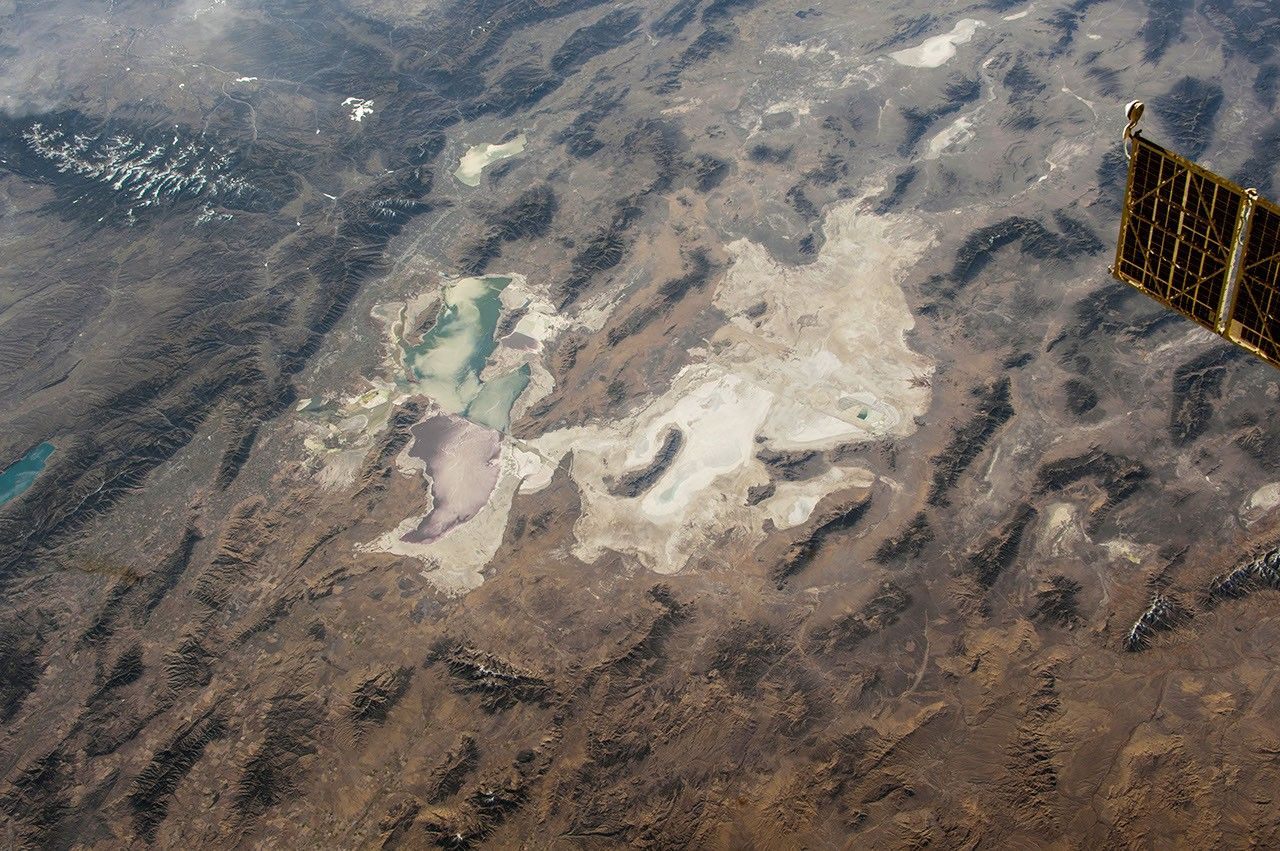
Salar de Uyuni, in Bolivia, is the largest salt flat in the world and is renowned for the mirror-like reflections that form across its surface after rain. The Bonneville Salt Flats, in Utah in the United States, occupy the remnant basin of a much larger ancient lake and have long been used for land speed record attempts because of their exceptional flatness. The Dasht-e Kavir, in Iran, is one of the largest salt deserts in Asia, while the Makgadikgadi Pan, in Botswana, represents a similarly extensive salt basin in southern Africa.
How It Continues to Change
Salt flats continue to change with the seasons far more than most landforms on this site, since many fill with a shallow layer of water during wetter periods and dry back into a hard crust during drier ones. Each cycle can redistribute minerals at the surface, reshape polygonal crust patterns, and, in basins with heavy mineral extraction from nearby mining, alter the overall balance of brine and crust more permanently. Long-term climate shifts toward wetter or drier conditions can also slowly expand or shrink a salt flat's active area over centuries.
How It Differs From Similar Formations
Salt flats are sometimes confused with ordinary deserts, but a desert is defined broadly by low rainfall and can include sand, rock, or gravel surfaces, while a salt flat is a specific closed-basin feature defined by its evaporite mineral crust. Salt flats are also related to, but distinct from, wetlands; both can involve shallow standing water at times, but a wetland is typically sustained by a consistent water supply and supports abundant vegetation, while a salt flat's defining feature is the mineral crust left behind once water evaporates away.
Common Misconceptions
Misconception: Salt flats are made of ordinary sand that happens to look white.
Reality: The surface is composed of crystallized evaporite minerals, chiefly halite, left behind by evaporating water, not windblown sand grains.
Misconception: Salt flats are permanently dry and never hold water.
Reality: Many salt flats, including Salar de Uyuni, flood with a thin layer of water during wetter periods, and some retain concentrated brine beneath the crust year-round.
Misconception: Every desert basin eventually develops a salt flat.
Reality: Salt flats require a closed basin with no drainage outlet, so water collecting there has nowhere to go except evaporation. Many desert basins drain to a river or the sea and never accumulate the standing water needed to concentrate minerals.
Key Terms
- Evaporite — A mineral deposit, such as salt or gypsum, left behind when a body of water evaporates.
- Deposition — The process by which sediment carried by wind, water, or ice is laid down and accumulates in a new location.
- Sediment — Solid material — fragments of rock, mineral grains, or organic matter — that is transported and deposited by water, wind, or ice.
- Groundwater — Water that exists beneath the Earth's surface in the cracks and pore spaces of soil and rock.
- Water Table — The upper surface of the saturated zone underground, below which all pore spaces are filled with water.
- Chemical Weathering — The breakdown of rock through chemical reactions, such as the dissolving of limestone by slightly acidic water.