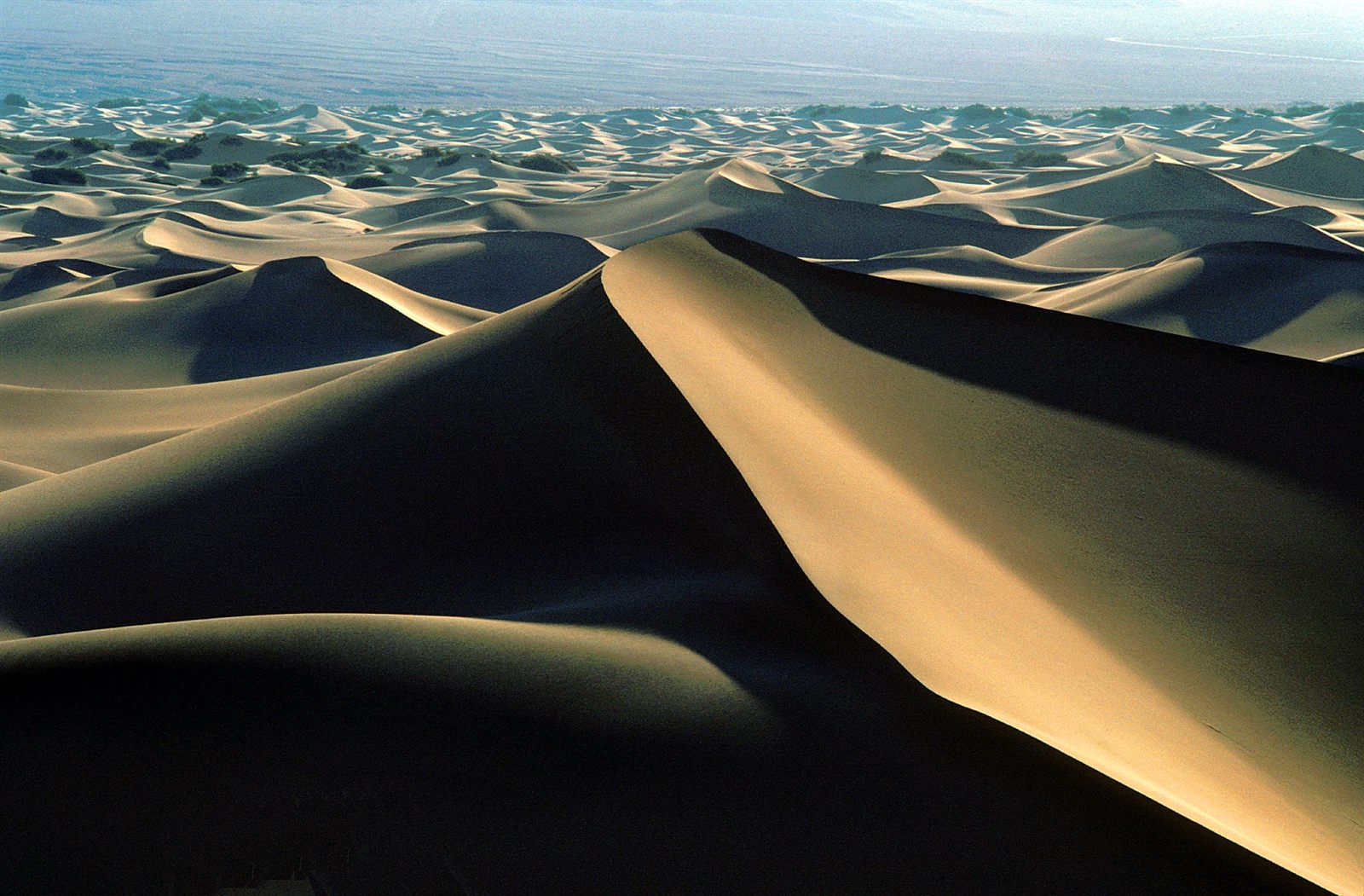
Definition
A sand dune is a mound or ridge of loose sand built up and shaped by wind. Dunes form wherever there is a sufficient supply of loose, dry sand-sized particles, enough wind to move them, and a surface where that sand can accumulate rather than simply blow away indefinitely. While most strongly associated with deserts, dunes also form extensively along coastlines wherever sandy beaches provide enough loose material for onshore winds to pick up and deposit further inland.
How It Forms
Dune formation and movement follow the same basic wind-driven mechanism, whether in a desert or along a coast.
- Wind picks up loose sand grains.
Once wind speed exceeds a certain threshold, it begins lifting and rolling loose sand grains along the surface in a process called saltation.
- An obstacle or irregularity causes sand to accumulate.
A small obstruction, a change in surface roughness, or even a random patch of denser sand can cause moving grains to slow down and begin piling up.
- The growing mound develops windward and leeward slopes.
As the pile grows into a dune, it develops a gently sloping windward face, where sand is pushed up, and a steeper leeward face, where sand slides down after cresting the top.
- The entire dune migrates downwind.
Because sand is continuously removed from the windward side and deposited on the leeward side, the whole dune effectively creeps forward in the direction the wind blows, sometimes by meters per year.
- Wind variability shapes the dune's final form.
Where wind blows consistently from one direction, simple ridge or crescent-shaped dunes tend to form; where wind direction varies seasonally, more complex star-shaped or branching dunes can develop instead.
Formation Timescale
Sand dunes are among the fastest-changing landforms covered on this site. Individual dune crests can shift visibly within days during a single strong windstorm, and whole dunes can migrate measurable distances, sometimes several meters, within a single year depending on wind strength and sand supply. Despite this relatively rapid movement, some large dune fields have persisted as a whole system in roughly the same region for thousands of years, even as the individual dunes within that system are constantly reshaping and repositioning themselves.
Main Characteristics
- Asymmetric cross-section: a gentler windward slope and a steeper leeward slope are typical of an actively forming dune.
- Sorted grain size: wind transport tends to concentrate similarly sized sand grains, distinct from the more mixed sediment left by water.
- Ripple patterns: smaller-scale ripples often cover a dune's surface, reflecting short-term wind patterns layered on top of the dune's overall shape.
- Variety of large-scale shapes: dunes can form as simple ridges, crescents (barchans), stars, or complex linear systems depending on wind variability.
- Active migration: many dunes are not fixed in place but continue to move gradually in the dominant wind direction.
Materials and Structures Involved
Most dunes are made of quartz sand, since quartz is a common, durable mineral that survives repeated wind transport without breaking down quickly. In some regions, dunes form from other materials entirely — gypsum sand at White Sands in New Mexico, for example, or dark volcanic sand in some coastal and desert settings. Grain size and shape significantly affect how easily sand moves and what kind of dune shape ultimately develops. Well-rounded, uniformly sized grains tend to move more readily than angular or mixed-size sediment, which is part of why dune sand often feels noticeably finer and more uniform underfoot than ordinary soil.
Climates and Environments
Dunes are most extensive in arid desert regions with abundant loose sand and strong, consistent winds, but they also develop readily along many coastlines, where onshore winds carry beach sand further inland, often becoming stabilized over time by coastal vegetation. In both settings, vegetation plays an important role in whether a dune keeps moving or becomes fixed in place: where plants can establish roots in the sand, they often slow or stop a dune's migration, while bare, actively moving dunes remain more dynamic.
The amount of moisture in the air and in the sand itself also affects how easily wind can pick up grains, which is part of why dune activity in many regions varies with the seasons rather than staying constant year-round. In wetter periods, a crust of moisture or a thin layer of vegetation can temporarily anchor a dune field that becomes active again once conditions dry out. This seasonal push and pull between stabilization and renewed movement is one reason dune fields in the same region can look noticeably different from one year to the next.
Real Examples
The Sossusvlei Dunes in Namibia are some of the tallest dunes on Earth, built from sand that has traveled long distances via rivers and ocean currents before being shaped by desert winds. The Great Sand Dunes in Colorado form an unusual high-elevation dune field trapped against the base of a mountain range. The Badain Jaran Desert in China contains some of the tallest stationary dunes in the world, alongside numerous small lakes in between them. The Simpson Desert in Australia contains extensive parallel linear dunes aligned with the region's dominant wind patterns. Each of these dune fields illustrates how local wind patterns, sand supply, and surrounding terrain combine differently to produce distinct large-scale dune forms.
How It Continues to Change
Dunes are rarely static. Wind continuously reshapes their surface ripples and overall profile, and many dunes migrate gradually across the landscape, occasionally burying vegetation, roads, or structures in their path. Changes in wind patterns, vegetation cover, or sand supply, whether from natural climate variability or human land use, can shift a dune field from actively migrating to largely stabilized, or vice versa, over periods of years to decades.
How It Differs From Similar Formations
Dunes are a specific landform within the broader category of deserts, but not all deserts contain significant dune fields, and dunes themselves can occur outside deserts entirely along coastlines. Dunes differ from salt flats, which form in enclosed desert basins through water evaporation rather than wind-blown sand accumulation. Compared to badlands, which are carved by water erosion into exposed soft rock, dunes are built up from loose, mobile material rather than cut into existing bedrock.
Common Misconceptions
Misconception: Dunes are permanent, fixed landforms.
Reality: Many dunes actively migrate over time, and their surface shape can change significantly within just days under strong wind conditions.
Misconception: All dunes have the same crescent shape.
Reality: Dune shape varies considerably, including simple ridges, crescent-shaped barchans, star dunes, and complex linear systems, depending mainly on how variable the local wind direction is.
Misconception: Dunes only occur in deserts.
Reality: Coastal dunes form wherever sandy beaches provide enough loose material for wind to carry further inland, regardless of the regional climate.
Key Terms
- Dune — A mound or ridge of sand built up by wind, typically found in deserts and along coastlines.
- Erosion — The wearing away and removal of rock, soil, or sediment by natural forces such as water, wind, or ice.
- Deposition — The process by which sediment carried by wind, water, or ice is laid down and accumulates in a new location.
- Abrasion — The wearing away of rock surfaces by friction, as sediment carried by ice, water, or wind scrapes against bedrock.
- Loess — A fine, wind-blown silt deposit that forms fertile, easily eroded soil in some plains regions.