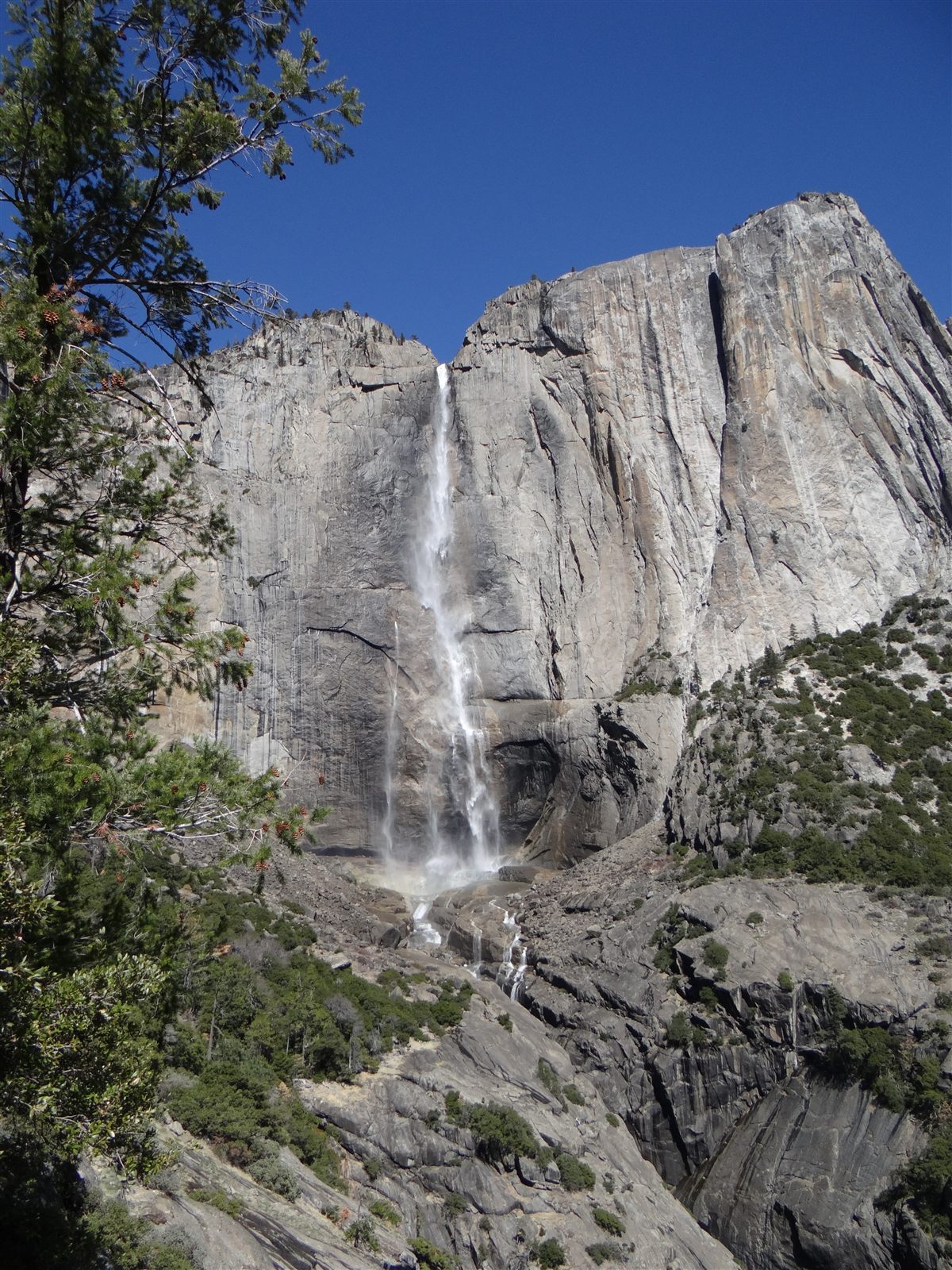
Definition
A waterfall is a point along a river or stream where water drops suddenly over a steep vertical or near-vertical section of the channel, rather than flowing down a gradual slope. Waterfalls range enormously in scale, from a small cascade a few feet high on a mountain stream to massive falls where an entire major river plunges tens or hundreds of meters at once. Despite their dramatic appearance, waterfalls are not permanent fixtures of the landscape; nearly every waterfall is actively being reshaped by the same water flowing over it, and many are slowly migrating upstream over time.
How It Forms
Waterfalls can form through several different mechanisms, but most share a common underlying cause: a sudden change in elevation along a river's path, often created or sharpened by the river eroding different rock types at different rates. The following steps describe the most common pathway, in which uneven rock hardness creates and then maintains a waterfall over time.
- A river crosses rock layers of different hardness.
Rivers frequently flow across rock that varies in resistance to erosion — a hard, durable layer such as resistant sedimentary or igneous rock sitting above or alongside a softer, more easily eroded layer. As the river wears away the landscape, the softer rock erodes faster than the hard rock.
- A step forms in the riverbed.
Because the softer rock downstream (or below) erodes more quickly, a distinct step or ledge develops in the riverbed where hard rock resists the current while surrounding material wears away. Water flowing over this step begins falling rather than flowing smoothly.
- The plunging water undercuts the ledge.
Falling water strikes the base of the waterfall with considerable force, often carrying sediment that scours out a plunge pool and erodes the softer rock beneath the hard ledge. This carves an overhang of harder rock projecting out above empty space.
- The overhang collapses and the falls retreats upstream.
Eventually the unsupported overhang breaks off under its own weight, and the waterfall's position shifts slightly upstream. This cycle of undercutting and collapse repeats indefinitely, causing many waterfalls to retreat upstream over time through a process called headward erosion.
Formation Timescale
The rate at which a waterfall changes varies enormously depending on rock type, water volume, and climate, and scientists are generally cautious about assigning a single number to the process. Niagara Falls, one of the best-studied waterfalls in the world, has retreated upstream at an estimated average of roughly one meter per year over the past several thousand years, though engineering changes to control erosion have slowed this significantly in recent decades. Smaller waterfalls over especially hard rock can remain in roughly the same position for a very long time, while waterfalls on softer rock, or those carrying large amounts of abrasive sediment, can retreat noticeably within a single human lifetime. Because of this wide range, waterfall change is generally described as a medium-timescale process, typically measurable over decades to thousands of years rather than single events or tens of millions of years.
Main Characteristics
- A sudden break in slope: the defining feature of a waterfall is an abrupt drop rather than a gradual decline in elevation.
- A plunge pool: many waterfalls carve a deep pool at their base where falling water and sediment scour the riverbed.
- An eroding overhang: a projecting ledge of resistant rock is common where softer rock beneath has been undercut.
- Retreat over time: most waterfalls slowly migrate upstream as erosion repeatedly undercuts and collapses the falls.
- Variable width and volume: a waterfall's width, height, and flow can change dramatically with seasonal rainfall or snowmelt feeding the river above it.
Materials and Structures Involved
The rock exposed at a waterfall almost always includes at least two layers of differing hardness: a resistant layer, commonly a dense sedimentary rock like dolomite or limestone, or a hard igneous or metamorphic rock, positioned above a softer, more easily eroded layer such as shale. The contrast between these materials is what allows a step to form and persist in the riverbed in the first place. Over time, the river also deposits rounded cobbles and sediment in the plunge pool below the falls, which can themselves act as abrasive tools that accelerate further erosion of the rock at the base.
Climates and Environments
Waterfalls occur in virtually every climate where rivers flow across uneven, resistant terrain, from tropical rainforests to arid canyon country to temperate mountain ranges. Climate strongly influences how a waterfall behaves: in regions with pronounced wet and dry seasons, a waterfall's volume can shift dramatically, sometimes reducing to a trickle or disappearing entirely during dry months. In cold climates, waterfalls may freeze partially or completely during winter, while in regions with heavy seasonal snowmelt, spring floods often carry the most sediment and cause the fastest rates of erosion and retreat.
Real Examples
Niagara Falls, on the border between the United States and Canada, is one of the most thoroughly studied waterfalls on Earth, prized both for understanding erosion and for hydroelectric power. Victoria Falls, on the border between Zambia and Zimbabwe, formed where the Zambezi River crosses a resistant band of basalt, creating one of the widest sheets of falling water in the world. Angel Falls in Venezuela, the tallest uninterrupted waterfall on Earth, drops from the edge of a tabletop plateau formed from extremely ancient, resistant rock. Iguazu Falls, shared by Argentina and Brazil, consists of hundreds of individual cascades spread across a wide stretch of river where a basalt layer creates a broad, stepped drop.
How It Continues to Change
Nearly every waterfall is in a constant, slow state of change. Many retreat upstream as undercutting and collapse repeat along the falls, gradually lengthening the gorge carved below them. Some waterfalls split into multiple channels or shift position when the river finds a new, lower path around a resistant rock mass. Human activity can also alter waterfalls directly or indirectly: dams and water diversion can reduce or eliminate flow, while engineered structures are sometimes used to slow natural erosion at heavily visited falls, as has been done at Niagara.
How It Differs From Similar Formations
Waterfalls are closely related to, but distinct from, canyons: a canyon is the long, deep channel a river carves over time, while a waterfall is typically the actively eroding "head" of that process, and many canyons, including sections of the Grand Canyon, began as a retreating waterfall. Waterfalls are also sometimes confused with rapids, but rapids involve fast, turbulent flow over an uneven but continuous slope, without the sudden vertical drop that defines a true waterfall.
Common Misconceptions
Misconception: Waterfalls are permanent features that stay in the same place.
Reality: Most waterfalls slowly retreat upstream as the rock beneath them is undercut and collapses, a process that has moved some famous waterfalls by kilometers over thousands of years.
Misconception: All waterfalls form the same way.
Reality: While differing rock hardness is the most common cause, waterfalls can also form where a fault has created a sudden drop, where a glacier has left a steep-sided valley, or where a river suddenly joins a much larger valley.
Misconception: A waterfall's height and flow never change.
Reality: Seasonal rainfall, snowmelt, drought, and human water management can all cause a waterfall's volume, and sometimes its visible height, to vary significantly throughout the year.
Key Terms
- Erosion — The wearing away and removal of rock, soil, or sediment by natural forces such as water, wind, or ice.
- Bedrock — The solid rock that lies beneath soil, sediment, and other loose surface material.
- Sedimentary Rock — Rock formed from the compaction and cementation of accumulated sediment over time.
- Headward Erosion — The gradual extension of a valley, gully, or stream channel upslope, toward its source, as erosion cuts further back.
- Tributary — A smaller stream or river that flows into a larger river rather than directly into a sea or lake.
- Drainage Basin — The area of land where all surface water, from rainfall to streams, drains to a common river or outlet.
- Sediment — Solid material — fragments of rock, mineral grains, or organic matter — that is transported and deposited by water, wind, or ice.