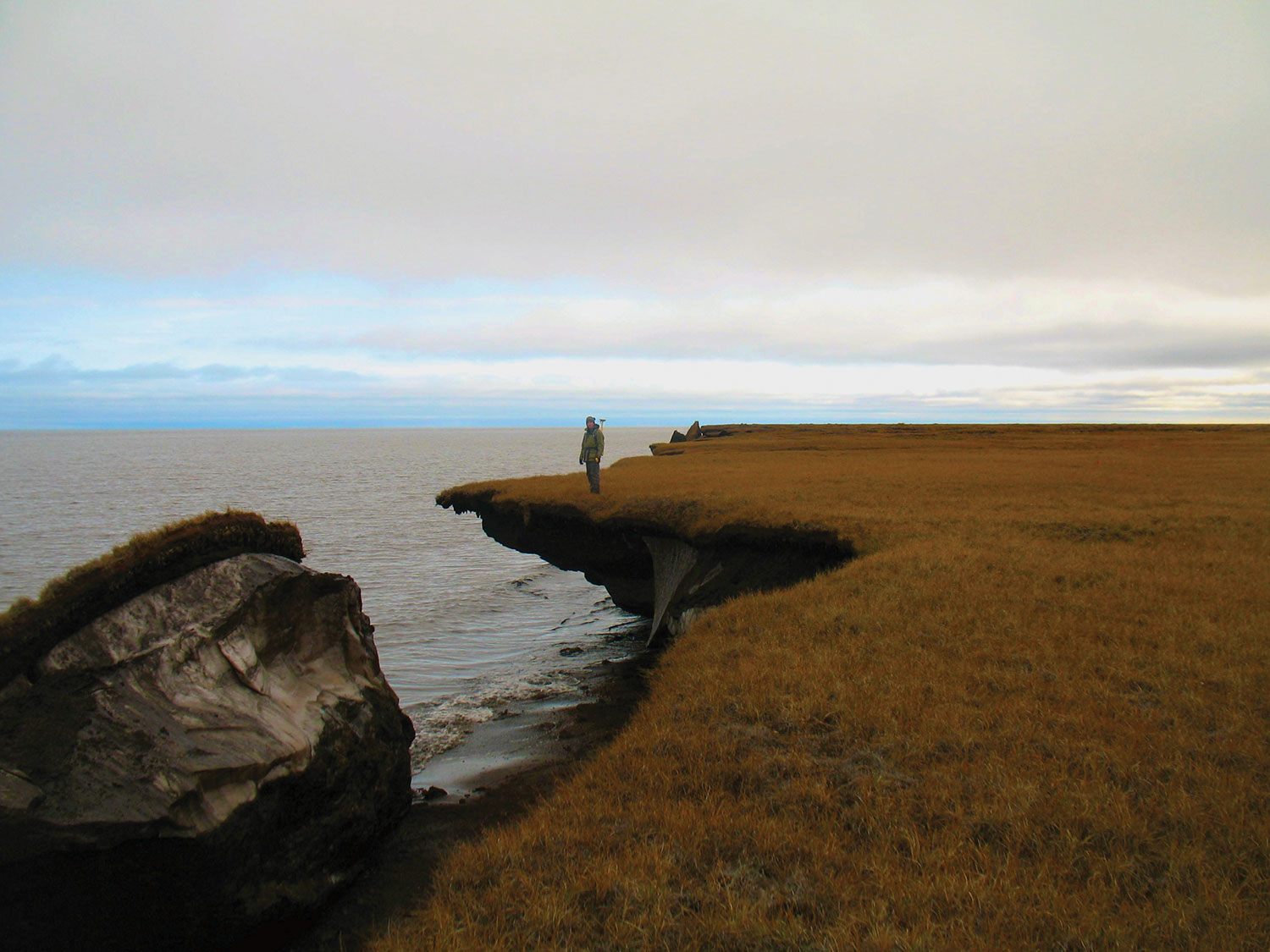
Definition
Permafrost is ground — soil, sediment, or rock — that remains at or below freezing temperature for at least two consecutive years, regardless of what covers its surface. It is defined purely by temperature and duration, not by whether the ground contains visible ice, although most permafrost does contain at least some frozen water. Permafrost underlies roughly a quarter of the land area in the Northern Hemisphere, concentrated across the Arctic and high-altitude regions, and can range from a thin layer just below the surface to material hundreds of meters deep in the coldest regions.
How It Forms
Permafrost forms and shapes the landscape through a combination of long-term freezing and a shorter seasonal cycle layered on top of it.
- Ground temperature stays below freezing long-term.
In sufficiently cold climates, the ground loses more heat than it gains over the year, allowing a persistently frozen layer to establish and deepen over time.
- A seasonal "active layer" develops above it.
Even where deep permafrost persists year-round, the uppermost layer of ground typically thaws each summer and refreezes each winter, called the active layer.
- Repeated freeze-thaw cycles move and sort material.
The expansion of freezing water and the settling that occurs during thaw physically push, sort, and crack the ground, gradually creating distinctive surface patterns.
- Ice wedges and ground ice grow over many cycles.
Water seeping into cracks during thaw can refreeze and expand the crack further each winter, slowly building vertical ice wedges that shape the surface into polygon-like patterns over centuries.
- Thawing permafrost can trigger collapse features.
Where permafrost containing significant ice thaws, whether seasonally at the margins or due to long-term warming, the ground can subside unevenly, forming thermokarst features such as small lakes and sinkhole-like depressions.
Formation Timescale
Permafrost itself can be extremely old in its coldest, most stable regions, with some deep permafrost in Siberia estimated to have persisted continuously for hundreds of thousands of years, though these estimates vary by location and are difficult to pin down precisely. The seasonal active layer above it, by contrast, operates on an annual cycle, thawing and refreezing every year. Surface features built up by repeated freeze-thaw action, such as ice wedge polygons, typically take centuries to thousands of years to reach their mature form.
Main Characteristics
- A frozen layer beneath a seasonally active surface: deep permafrost persists while the shallow active layer above it cycles annually.
- Patterned ground: repeated freeze-thaw action often creates distinctive polygon, stripe, or mound patterns visible on the surface.
- Ice wedges and ground ice: frozen water within the permafrost significantly affects ground strength and behavior.
- Thermokarst features: localized thawing can create irregular small lakes, depressions, or slumping ground.
- High sensitivity to temperature change: because it exists near the freezing threshold, permafrost can respond relatively quickly to sustained warming.
Materials and Structures Involved
Permafrost can form in almost any ground material — bedrock, gravel, sand, silt, or peat — with its physical behavior depending heavily on how much ice it contains. Ice-rich permafrost, common in fine-grained soils with high water content, is especially prone to dramatic changes upon thawing because melting ice leaves voids that the ground then settles into unevenly. Rockier, drier permafrost tends to be more stable and changes less dramatically even if its temperature rises somewhat. Some permafrost also contains visible, massive ice bodies rather than ice distributed through the soil, and these can be especially vulnerable to rapid thaw once exposed at the surface.
Climates and Environments
Permafrost occurs in polar regions and at high elevation wherever average annual temperatures remain cold enough, spanning much of Siberia, northern Canada and Alaska, and parts of the Tibetan Plateau. These regions typically support specialized vegetation adapted to short growing seasons and shallow rooting depth, since roots generally cannot penetrate the frozen layer below the active zone. Permafrost regions are also significant for storing large amounts of organic carbon that has accumulated in frozen soil over thousands of years.
Real Examples
The Siberian permafrost region in Russia contains some of the oldest and most extensive permafrost on Earth, including areas with well-preserved ancient organic material. The Alaskan North Slope in the United States supports extensive patterned ground and thermokarst lakes typical of Arctic permafrost terrain. The Canadian Arctic Archipelago contains permafrost landscapes shaped by both ancient glacial history and ongoing freeze-thaw processes. The Tibetan Plateau contains extensive high-altitude permafrost, distinct from polar permafrost because it results from elevation rather than latitude. Comparing these regions helps researchers separate the effects of latitude, elevation, and local ground material on how permafrost behaves.
How It Continues to Change
Permafrost regions are currently experiencing significant change as Arctic and high-altitude temperatures rise faster than the global average in many locations. Thawing permafrost can cause ground subsidence that damages infrastructure, alters drainage patterns, and releases previously frozen organic carbon, which can affect the carbon cycle as it decomposes. Because permafrost responds to temperature changes with some delay due to the ground's thermal mass, some current thawing reflects warming that has already occurred rather than only current conditions.
Communities built on permafrost have had to adapt infrastructure, from roads to buildings, to account for ground that is less stable than it once was, sometimes using specialized foundations designed to minimize heat transfer into the frozen soil below. Researchers also monitor permafrost temperature at various depths over long periods to track how quickly the frozen layer is responding to surface warming in different regions, since the rate of change varies considerably depending on local ice content and ground composition.
How It Differs From Similar Formations
Permafrost is often confused with glaciers, but the two are fundamentally different: a glacier is a moving body of ice built from accumulated snow, while permafrost is frozen ground that may or may not contain significant ice and does not flow in the same way. Permafrost-related thermokarst lakes can resemble features created by other processes, such as sinkholes, but form through ice melting and ground subsidence rather than the dissolution of soluble rock.
Common Misconceptions
Misconception: Permafrost means the ground is frozen solid all the way to the surface year-round.
Reality: Most permafrost regions have a seasonally thawing active layer at the surface even while deeper ground remains frozen throughout the year.
Misconception: Permafrost is unaffected by what happens above it.
Reality: Permafrost temperature and stability respond to surface conditions, including vegetation, snow cover, and air temperature, sometimes with a delay of years.
Misconception: Permafrost only matters locally where it occurs.
Reality: Thawing permafrost can affect global systems by releasing stored organic carbon, giving permafrost regions significance well beyond their immediate landscape.
Key Terms
- Permafrost — Ground, including soil and rock, that remains frozen for at least two consecutive years.
- Weathering — The breakdown of rock in place, through physical, chemical, or biological processes, without the material being transported away.
- Groundwater — Water that exists beneath the Earth's surface in the cracks and pore spaces of soil and rock.
- Talus — An accumulation of broken rock fragments at the base of a cliff or steep slope, formed by repeated rockfall.
- Erosion — The wearing away and removal of rock, soil, or sediment by natural forces such as water, wind, or ice.